ODM Activewear Manufacturer Turning Product Direction Into Bulk-Ready Production
MOVEVOX supports activewear brands that have a clear product direction but still need manufacturing-led development before production specifications are complete. We translate concepts, sketches, reference inputs and partial technical information into manufacturable fit, materials, construction and sample decisions, then carry the buyer-approved standard through Seamless or Cut & Sew production under controlled quality and project management.
- Manufacturing-led development from concept, sketch or incomplete technical input.
- Approx. 8-person development system covering design, pattern and sample making.
- Seamless and Cut & Sew routes supported within one managed system.
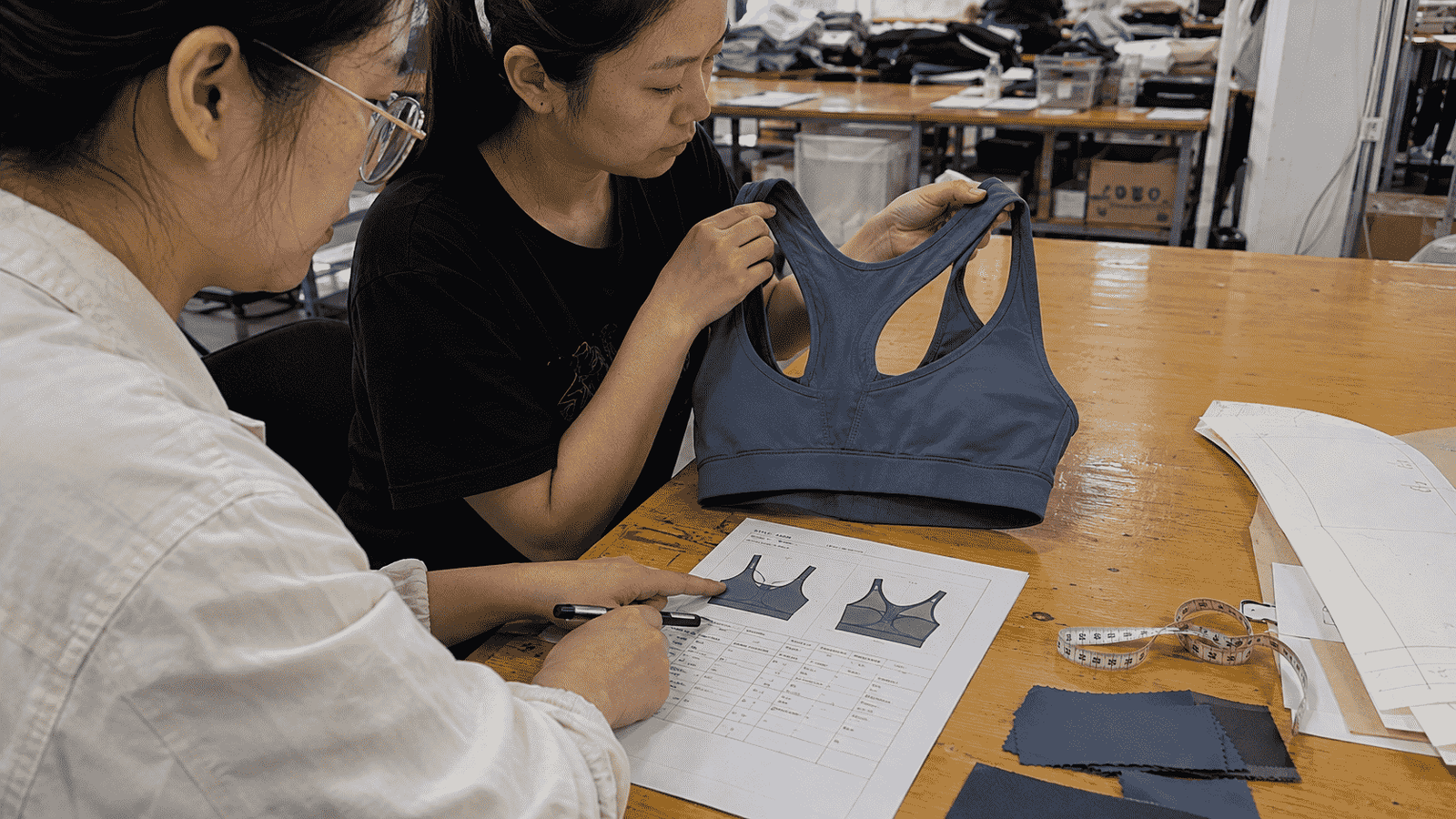
Approx. 8 people across design, pattern and sample development.
Choose the Right Activewear Development Route
OEM, development-led ODM and Private Label begin from different levels of product readiness. MOVEVOX uses these routes to clarify what the buyer already controls, what requires manufacturing development and which decisions must be approved before bulk production.
| Decision Point | OEM | Development-Led ODM | Private Label |
|---|---|---|---|
| Starting Point | Complete Tech Pack or controlled product specification ready for manufacturing review. | Clear product direction with incomplete engineering or production specification. | Existing product platform selected for approved branding and presentation customization. |
| Buyer Provides | Tech Pack, measurements, BOM, artwork, materials and key approval requirements. | Target customer, product goal, references, functional priorities, commercial targets and development feedback. | Product selection, logo artwork, colors, labels, packaging and required brand information. |
| MOVEVOX Handles | Manufacturability review, sampling, production engineering, quality control and controlled bulk execution. | Manufacturing translation, material and structure recommendations, sampling, revision and production-standard development. | Approved product customization across branding, color, labels and packaging scope. |
| Design Direction | Buyer-controlled specification remains the governing basis for manufacturing execution. | Buyer controls brand direction while product engineering is developed collaboratively for manufacturing. | Existing product platform remains the base while approved branding elements are customized. |
| Sample Purpose | Verify buyer specifications before the released standard enters bulk production. | Turn product direction into measurable, manufacturable and buyer-approved production references. | Confirm the selected product and customized brand-facing elements before production. |
| Buyer Approval | Required for revisions and the final production standard before bulk release. | Required for development direction, samples and the final manufacturing specification. | Required for product selection and all customized branding elements. |
| Best Suited For | Brands with established internal technical specifications and product-development resources. | Brands with clear product objectives requiring manufacturing-led engineering before bulk production. | Buyers seeking faster brand execution from an established product development base. |
Choose development-led ODM when your brand already knows the product direction, user, performance priorities or visual language, but the product still needs fit, material, structure and manufacturing decisions before it becomes production-ready. MOVEVOX supports that engineering translation and sample validation process. Your team continues to control brand direction and major product approvals; MOVEVOX does not replace your brand strategy, naming, commercial planning or final decision-making.
How Product Direction Becomes Bulk-Ready Activewear
MOVEVOX treats product development as a controlled manufacturing path. Whether the starting input is a concept, sketch, image, sample or technical file, development must eventually produce approved specifications and physical references that production and QC can follow.
Development Input
The project starts from the information your team already controls, which may include a concept, sketch, image, legal reference sample, complete or incomplete Tech Pack, fabric swatch or related technical information.
Engineering Review
MOVEVOX translates the product direction into questions about category, fit, measurements, material, construction, manufacturing route, branding, MOQ, cost and risk.
Development Setup
Confirmed decisions move into pattern development or Seamless program preparation together with material, construction and product-specific requirements.
Sample Validation
The sample is checked internally and reviewed by the buyer against the purpose of that sample stage. Fit, structure, material, workmanship or branding comments enter the current revision path.
Revision Control
Approved comments are translated into the current pattern, Seamless program, measurement, material or construction decisions using one controlled instruction set.
Production Release
Once the defined product scope is approved, current specifications and the Approved or PP Sample become production references for pre-production and first-article control.
Sample timing: Standard sample development is typically approximately 5–10 working days after the required development details are confirmed. Product complexity, custom materials, colors, branding processes and buyer revision cycles can change actual timing.
What We Need From Your Product Concept
A complete Tech Pack is not required to begin a concept review. However, the concept must be translated into specific product, user, fit, material, functional and commercial decisions before MOVEVOX can build a controlled development sample.
Target User
Define who the product is intended for and the intended product positioning. This provides context for fit, material, support, coverage and product-use decisions.
Activity Context
Explain whether the product is intended for yoga, Pilates, gym, training, running, athleisure or another defined use.
Product Direction
Identify the intended category and key visual or structural direction, such as leggings, sports bra, shorts, top or coordinated set.
Fit Direction
Describe the intended silhouette, rise, length, body relationship and general fit language. Missing critical dimensions become explicit development and approval points.
Material Feel
Describe practical priorities such as softer handfeel, more compression, lighter weight or greater coverage so material directions can be evaluated against the product.
Functional Priorities
Identify commercially important functions such as support, stretch, recovery, opacity, pocket use or targeted Seamless structures.
Brand Direction
Provide available color direction, logo placement, label requirements, packaging expectations or visual references.
Commercial Targets
Share estimated quantity, target cost where available, intended launch timing and important MOQ constraints before the development route is finalized.
MOVEVOX can help organize incomplete concept information into a development brief, but critical product decisions still require buyer confirmation. The process translates your product direction into manufacturable specifications; it does not replace brand strategy, market positioning, sales forecasting or final product approval.
Translate a Sketch Into Production Decisions
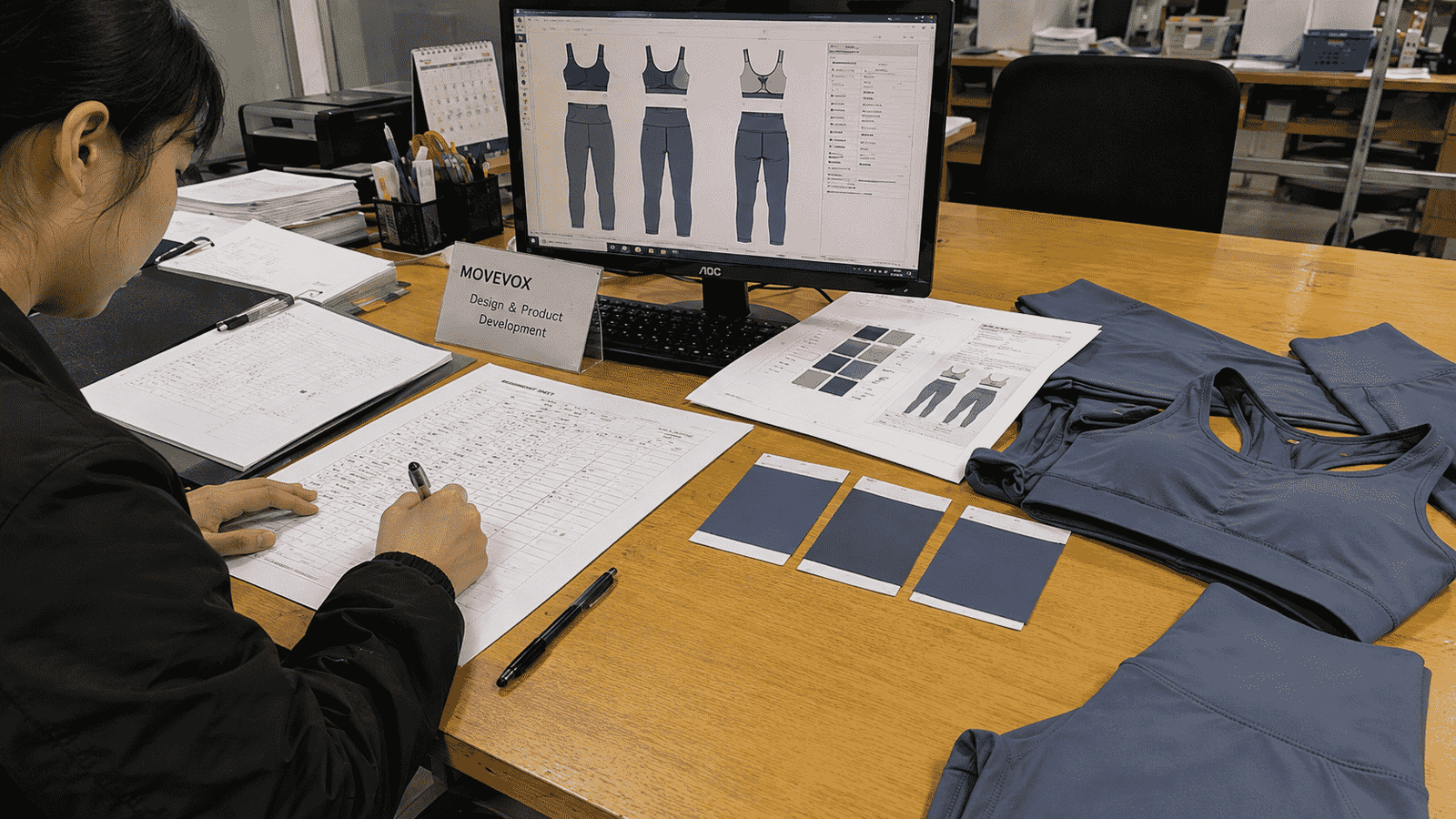
A sketch communicates visual intent, but production requires measurable structure. MOVEVOX translates lines, proportions and design details into pattern or Seamless decisions, materials, construction and defined approval points before the sketch becomes a sample.
Product Proportion
The sketch is reviewed for silhouette, length, rise, neckline, leg or sleeve proportion and other visible relationships.
Fit Points
Visual shape is converted into measurable fit requirements and key points of measurement before sample execution.
Pattern Structure
For Cut & Sew products, visual lines are translated into practical panels, seams and construction relationships.
Seamless Zones
For Seamless products, design lines may become knitted rib, mesh, texture or other engineered structural zones.
Material Mapping
Intended appearance is reviewed against stretch, recovery, handfeel, coverage and construction requirements.
Brand Details
Logo, trim, opening, pocket and other visible elements are reviewed for location, scale and manufacturing method.
Sketch development is not a process of copying lines directly into production. MOVEVOX separates visual intent from technical assumptions, then defines the pattern or Seamless structure, fit references, material direction and construction needed to build the product. If the original execution is unsuitable for stable manufacturing, alternatives are evaluated against appearance, handfeel, MOQ, cost and production feasibility before buyer approval.
Choose Differentiation That Can Be Manufactured
Product differentiation is useful only when it remains compatible with fit, materials, MOQ, cost and repeatable production. MOVEVOX uses manufacturing constraints to narrow broad ideas into a small number of development directions for buyer review.
What should feel different?
Where should design differ?
Which route fits best?
What commercial limit matters?
What requires validation?
Fit-Led Direction
Use fit and proportion as the main differentiation lever, for example waistband shape, rise, length, back structure or silhouette. The requested change is reviewed against pattern or Seamless engineering, measurements and sample approval.
Structure-Led Direction
Differentiate through construction, pockets, panels, straps, Seamless textures or engineered zones where technically suitable.
Material-Led Direction
Use material handfeel, stretch, recovery, coverage or compression direction as a product differentiator and validate candidate materials against actual product requirements.
Branding-Led Direction
Color, logo execution, labels and packaging can create visible brand distinction, while each process is separately reviewed for MOQ, cost and timing implications.
Select Fabric Against the Product Requirement
Fabric recommendation starts from the intended activity, fit, handfeel, stretch, recovery, coverage and commercial requirements. MOVEVOX compares suitable material directions and trade-offs before a candidate fabric becomes part of the approved development standard.
Activity & Product Use
Material direction begins with the intended product category and use environment rather than a generic fabric name.
Stretch & Recovery
Stretch behavior and recovery are reviewed together with fit, construction and the movement demands of the product.
Coverage & Opacity
Coverage requirements are considered against material weight, stretch level, color and the intended garment structure.
Handfeel
Softer, smoother, brushed or more supportive directions are compared against the actual product requirement and manufacturing route.
Compression Direction
Compression requirements must be evaluated together with fit, recovery and user comfort rather than treated as a standalone claim.
MOQ & Availability
Standard materials and dedicated custom materials may carry very different supplier minimums and development conditions.
Color & Finish
Custom color, finish or yarn development may require separate approval, sourcing and minimum-quantity conditions.
Evidence & Testing
Performance, certification or compliance claims should be supported by relevant supplier documents or project-specific testing where required.
MOVEVOX does not treat a fabric name or composition alone as sufficient evidence of suitability. A lighter material may reduce coverage, stronger compression may change handfeel, and specialized material development can increase effective MOQ or lead time. Candidate fabrics should therefore be compared against the actual product, fit, target experience and commercial conditions, then validated through samples and relevant supplier data or testing where required.
Improve Construction Before It Becomes Production Risk
A structure may look acceptable in one sample but still be unsuitable as the default bulk-production route. MOVEVOX reviews how design intent interacts with stretch, load, thickness, movement, manufacturing method and repeatability before recommending a construction path.
Unclear Seam Logic
A sketch can show a visual seam line without defining whether it is structural, decorative or required for fit and material control.
Define the Construction Purpose
MOVEVOX translates the line into an appropriate Cut & Sew panel, seam or alternative visual treatment, then confirms its purpose and appearance through sampling before release.
Stress-Point Construction
Highly stretched or load-bearing areas can place different demands on seams, edge finishes and local reinforcement than surrounding areas.
Validate Against Product Use
Construction is reviewed against intended use, material behavior and stress location before alternative seam or reinforcement options are validated through sampling.
Excess Seam Bulk
Multiple panels, bindings or layered components can create excessive thickness when design focuses only on the external visual effect.
Review Assembly & Layering
Panel intersections, edge construction and assembly sequence can be reviewed to reduce unnecessary buildup while protecting the intended visual language.
Unstable Edge Finish
High-stretch edges or openings may roll or distort when material and construction do not work together under use.
Validate Material and Finish Together
Material behavior, edge geometry and available finishing methods are reviewed as one system before the final construction is released.
Seamless Zone Limits
A graphical Seamless concept may contain lines or boundaries that cannot be reproduced exactly as drawn through knitted structures.
Translate Into Knitted Structure
MOVEVOX converts visual intent into feasible rib, mesh, texture or engineered zones and identifies where adjustments require buyer review.
Construction recommendations are not automatic design changes. MOVEVOX identifies manufacturing risk, proposes feasible options and explains relevant trade-offs in appearance, feel, MOQ, cost or process complexity. The buyer remains responsible for approving the preferred route.
Identify Development Risk Before It Reaches Bulk
ODM development contains uncertainty because the product specification is still being built. The objective is not to remove every unknown immediately, but to identify which decisions can affect fit, material, construction, MOQ, timing or production consistency before those risks become embedded in bulk.
Incomplete Product Inputs
A concept may describe the intended product without defining measurements, construction, material or detailed branding requirements.
Verify: Record open points and buyer-confirmation items before sampling begins.
Fit-Material Conflict
Fit cannot be evaluated independently from stretch and recovery in high-elasticity activewear.
Verify: Review fit and relevant material behavior together before formal fit approval.
Unvalidated Custom Material
Custom fabric, yarn, finish or color can introduce separate sourcing, MOQ, development and testing requirements.
Verify: Confirm material route, availability and bulk conditions before specification freeze.
Construction Complexity
A visually attractive structure may create excessive seam bulk, difficult assembly, unstable edges or other production concerns.
Verify: Compare feasible construction options and validate the selected route through samples.
Branding Dependency
Custom logos, labels, trims or packaging can carry separate artwork, tooling, supplier MOQ and timing requirements.
Verify: Track brand-facing components as separate approval and sourcing dependencies.
Revision Drift
Multiple comments across email, messages or meetings can create conflicting sample instructions without one current Revision List.
Verify: Consolidate each revision round into one written and version-controlled instruction set.
Shared SKU Dependency
A multi-SKU collection may depend on common material, fit, color or branding decisions that can multiply revisions across the collection.
Verify: Lock shared dependencies first and release priority SKUs in controlled development waves.
Continue Development Even When Your Tech Pack Is Incomplete
An incomplete Tech Pack does not automatically stop development. MOVEVOX can review the information already available, identify missing technical and commercial decisions, separate items that must be confirmed before sampling from those that can be refined later, and build a controlled development version for buyer approval.
Fabric
Confirm whether material composition, weight, stretch, handfeel, finish or sourcing direction is defined sufficiently for development.
Measurements
Identify missing base-size measurements, key points of measurement, tolerances or grading information that can affect fit approval.
Construction
Review undefined seams, panels, edge finishes, Seamless structures or other construction details that require engineering decisions.
Logo & Branding
Check artwork, size, color, placement and intended branding process where these details are part of the product specification.
Trims
Identify missing specifications for elastic, pads, zippers, drawcords, labels or other components used by the product.
Color
Confirm whether the project uses an approved standard color, Pantone reference, physical swatch or a custom color-development route.
Labels & Packaging
Review main labels, care labels, size labels, hangtags, barcodes, polybags and other brand-facing packing requirements where applicable.
Testing Requirements
Identify buyer, market or product-specific testing requirements early enough for them to be incorporated into development planning.
Gap Review
MOVEVOX reviews the existing file set and identifies missing, conflicting or unclear product information before development begins.
Clarification
Open points are separated into buyer decisions, supplier confirmations and engineering items that MOVEVOX can propose.
Engineering Proposal
MOVEVOX can propose suitable material, construction, basic sizing, trim, branding or packaging solutions where the buyer has not yet defined them.
Buyer Approval
Proposed decisions affecting appearance, fit, function, cost or MOQ are confirmed before becoming part of the current development standard.
Development Sample
Approved information is converted into an executable sample version for physical validation and the next development decision.
MOVEVOX does not use factory defaults to replace undefined brand requirements without review. Missing information can be developed progressively, but decisions affecting product appearance, fit, function, commercial conditions or bulk execution remain subject to buyer confirmation.
Turn a Physical Reference Sample Into a Controlled Development Brief
A physical garment can provide valuable information about fit, structure, material behavior and construction, but it should not be treated as an instruction for uncontrolled copying. MOVEVOX analyses the reference, records measurable characteristics and identifies which elements can be reproduced, modified or require alternative engineering.
Sample Receipt
The reference garment is identified and documented as a project input before technical analysis begins.
Measurement Mapping
Key dimensions, proportions and relevant fit references are measured and recorded for development review.
Construction Mapping
Panels, seams, Seamless structures, edge finishes, internal components and assembly logic are reviewed where they can be identified.
Material & Trim Analysis
Handfeel, stretch, recovery, visible material characteristics, trims and branding processes are reviewed against available sourcing options.
Difference List
Variables that cannot be matched reliably, such as unavailable original yarn, finishing or dedicated components, are identified before sample development.
Development Proposal
MOVEVOX proposes the development route, expected differences and required buyer decisions before creating the new sample version.
Reference Sample Boundary
Physical-sample development is supported when the reference is legally usable by the buyer. MOVEVOX does not treat third-party trademarks, protected logos or counterfeit replication as a normal development route. Where original materials, yarns, finishes or dedicated trims cannot be obtained, the proposed alternative and relevant differences are communicated before approval.
Control Multi-SKU Development Through Planned Product Waves
When inputs and material paths are sufficiently clear, MOVEVOX can manage approximately 10–20 SKUs at different development stages. Larger projects are normally easier to control when shared dependencies are confirmed before priority styles are released in development waves.
Project Setup
Create the SKU structure, owners, project inputs and priority list before individual development begins.
Shared Dependencies
Identify common fabric, fit, color, construction, logo, label or packaging decisions that affect more than one SKU.
Wave Control
Larger programs can typically organize approximately 5–10 priority SKUs per development wave depending on product complexity and dependencies.
Individual Versioning
Each SKU maintains its own version, BOM, sample status and approval record even when it shares a collection platform.
Wave Review
Shared material, fit and construction decisions are reviewed before unresolved issues are allowed to spread into later styles.
Final Release
Each SKU is released according to its own approval and bulk-readiness status rather than one automatic collection-level approval.
Multi-SKU timing depends on shared materials, fit conclusions, colors and branding decisions. Current MOVEVOX facts support approximately 10–20 SKUs at different development stages when inputs and material paths are clear, while individual SKU approvals remain independently controlled.
Build Collections Around Controlled Shared Product Platforms
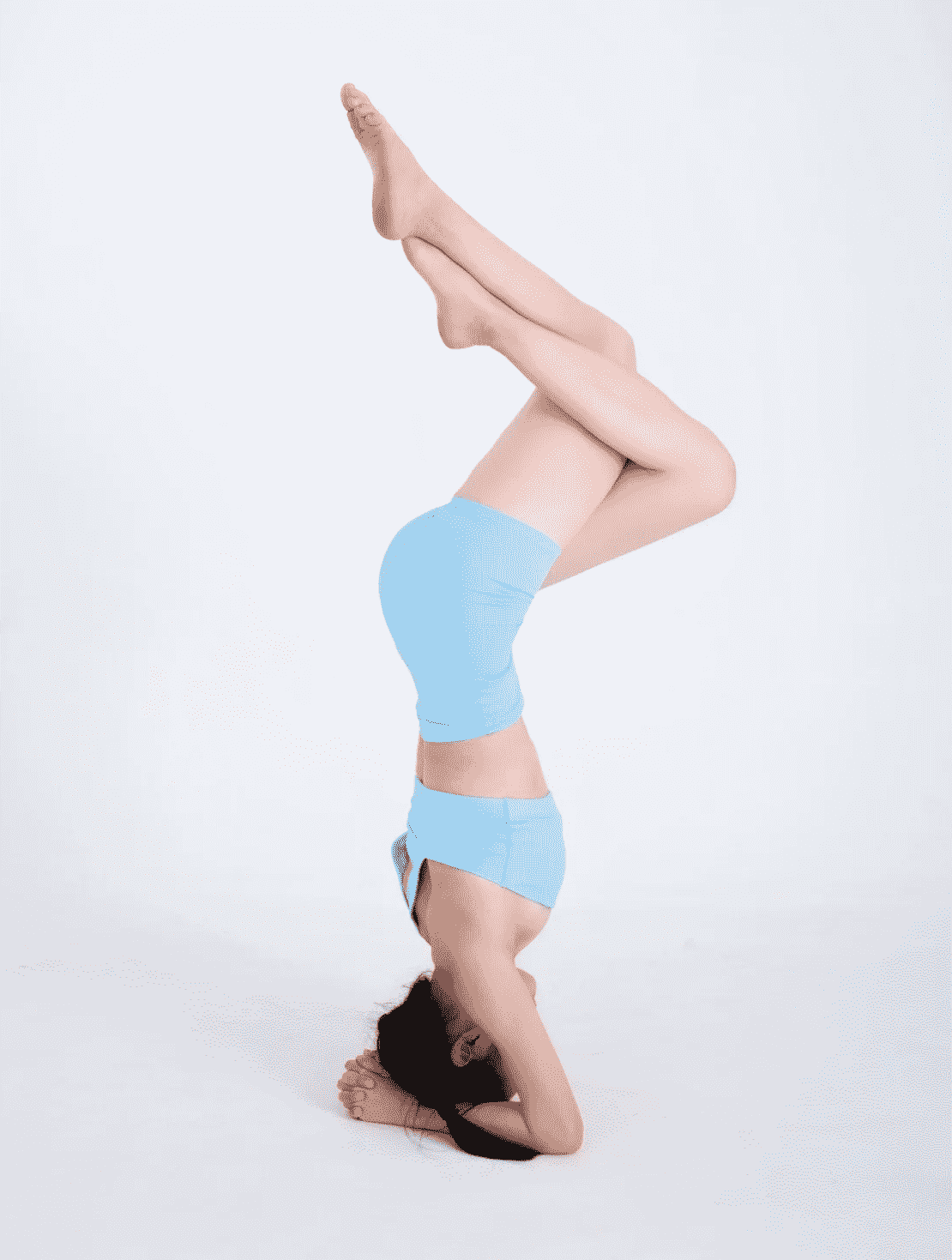
Collection development does not require every SKU to start from zero. Where suitable, related products can share controlled material, fit, color, branding or packaging rules while each style keeps its own specification and approval status.
Yoga / Pilates Core
Connect leggings, sports bras, shorts and tops through selected shared materials, color direction and branding rules while preserving product-specific fit and construction.
- Yoga Leggings
- Sports Bra
- Yoga Shorts
- Tank Top

Gym / Training Range
Organize fitted bottoms, bras, tanks or long-sleeve tops around selected common material and branding decisions while keeping product-specific fit and performance requirements.
- Training Leggings
- Sports Bra
- Tank Top
- Long Sleeve
Mixed Manufacturing Range
A collection can include Seamless and Cut & Sew products while coordinating color, branding and selected material direction across separate manufacturing routes.
- Seamless Bottom
- Seamless Bra
- Cut & Sew Top
- Coordinated Set
A collection platform is a development-management method, not a stock collection or a guarantee that every SKU should share identical materials. The buyer and MOVEVOX determine which background variables can reasonably be standardized and which visible or functional variables should remain different.
Can the Design Become Stable Bulk Production?
A product that can be made once is not automatically ready for repeatable bulk production. MOVEVOX reviews material availability, manufacturing route, structural stability, sizing consistency, branding compatibility, inspection feasibility and production complexity before the development route is released.
Ready to Develop
The proposed material, construction and manufacturing route are sufficiently clear and suitable to proceed into controlled development.
- Manufacturing route is available
- Structure is technically executable
- Key requirements are sufficiently defined
Validation Required
The product may be workable, but one or more variables require sample, material, fit, construction or process validation before the route should be frozen.
- Sample verification required
- Material or structure remains conditional
- Approval depends on test results
Adjustment Required
The current route presents a significant risk to repeatable bulk production, product consistency or commercial feasibility and should be revised before development continues.
- High repeatability risk
- Material or process conflict
- Alternative engineering required
Protect the Product Intent
Where adjustment is required, MOVEVOX first aims to preserve the intended appearance and function, then evaluates changes to construction, process route, material parameters or component specification.
- Maintain intended product outcome
- Explain technical trade-offs
- Confirm changes before release
Specification Freeze
Approved engineering decisions are incorporated into the current technical version.
Approved Sample
The relevant physical sample becomes part of the approved production reference.
Pre-Production Review
Materials, construction, branding, quality requirements and open risks are reviewed before scale.
First Article
Actual bulk conditions are checked against the released development standard.
Corrective Action
Failed requirements are corrected and reverified before wider production.
Bulk Release
Production expands after required technical and approval gates are satisfied.
Sample possible does not automatically mean bulk stable. Manufacturability review is intended to identify risks while changes are still less costly to evaluate and correct.
Build Sizing Around Your Brand, Product and Target Fit
MOVEVOX does not apply one universal factory size chart to every brand. When the buyer already has an approved size specification, that standard remains the starting point. When sizing is incomplete, development must establish a base size, key measurements, fit direction and grading logic before the size range can be approved.
Customer Size Chart
Existing buyer measurements, points of measurement and tolerances take priority where a controlled size specification already exists.
Base Size
Where sizing is incomplete, the base size is developed from the target customer, product category, reference information and intended fit direction.
Key POM
Critical points of measurement are identified according to product structure rather than relying only on a generic market-size label.
Fit Sample
The base-size sample validates the relationship between measurements, material stretch, structure and the intended product fit.
Grade Rule
Size progression is developed according to product structure, material behavior and approved fit rather than mechanically scaling every measurement by the same amount.
Size Set
Where required, representative or full sizes are checked to verify grading, measurements and fit progression before final approval.
07 — Size Approval
The approved measurement specification, grading logic and relevant physical sample become part of the released production standard. Buyer-defined measurements and tolerances remain the governing reference where they are provided.
The Same “M” Is Not the Same Across Brands
Market labels such as S, M or L are useful for communication, but they are not sufficient manufacturing specifications. Production sizing should be based on approved measurements, measurement methods, tolerances, fit samples and grading rules.
- Buyer standards take priority where available.
- Material stretch influences fit interpretation.
- Leggings and sports bras require product-specific grading logic.
- Seamless structures require engineering review across sizes.
- Critical load-bearing areas should not be scaled mechanically.
- Final sizing remains subject to buyer approval.
Start With What You Have — Then Close the Gaps in Order
ODM development does not require every technical file to be complete before an initial review can begin. The information below shows what is sufficient to start a discussion, what improves development accuracy and what must ultimately be controlled before bulk production.
Enough for Initial Development Review
- Product category
- One valid reference input
- Target quantity
- Target market
- Basic brand or project information
A valid reference can be a Tech Pack, physical sample, product image, sketch, written concept or fabric swatch.
Information That Improves Development Decisions
- Measurement chart
- BOM or material direction
- Fabric specification
- Color or Pantone direction
- Logo artwork
- Label requirements
- Packaging requirements
- Target cost
- Target timing
Information That Must Become Controlled
- Released product specification
- Approved measurements and tolerances
- Approved materials and colors
- Approved construction
- Approved logo and brand components
- Approved labels and packaging
- Required quality or testing conditions
- Approved sample reference where applicable
Incomplete information is not automatically a barrier to initial review. However, the more accurately product, fit, material and commercial requirements are defined, the easier it becomes to evaluate sample accuracy, effective MOQ, cost and development risk.
Development Capability That Continues Into Manufacturing
MOVEVOX is structured for brands that need more than a one-off sample. Product-development inputs are translated into controlled technical decisions, physical samples and buyer-approved standards that can continue into the appropriate manufacturing route.
Development Team
Approx. two design, two pattern and four sample-development roles support product engineering and sample execution.
Manufacturing Routes
Seamless and Cut & Sew development can be evaluated according to the engineering requirements of each product.
Working Days
Standard sample development is typically approximately 5–10 working days after the required development details are confirmed.
SKUs in Development
When inputs and material paths are sufficiently clear, approximately 10–20 SKUs can be managed at different development stages.
Priority SKUs per Wave
Larger programs can be organized into controlled development waves instead of allowing shared variables to create uncontrolled revisions.
The purpose of this development system is not to replace the buyer’s brand or product decisions. MOVEVOX provides manufacturing translation, technical review and development execution while the buyer retains approval of major product direction and the released standard.
Understand MOQ Before Finalizing Your ODM Development Route
ODM development can change effective MOQ because material, color, construction, branding and packaging decisions are still being defined. MOVEVOX therefore evaluates the commercial starting point against the actual development specification rather than one universal quantity.
| Order Element | Standard Starting Point | What Can Change It | Buyer Note |
|---|---|---|---|
| Seamless Garments | Approx. 100 pcs/style | Custom yarn, color, program complexity, logo tooling or packaging can increase effective MOQ. | Treat 100 pieces as a normal starting point, not a universal minimum. |
| Cut & Sew Garments | Approx. 150 pcs/style | Custom fabric, special finishing, trims, branding or packaging can increase effective MOQ. | Applies under normal material and construction conditions. |
| Standard Color Split | 50 pcs/color for standard or shared supply-chain colors | Independently dyed custom colors carry separate material minimums. | Color allocation must still fit the style and total order quantity. |
| Standard Size Split |
Seamless ≥20 pcs/size; Cut & Sew ≥10 pcs/size |
Extreme sizes or structures requiring separate engineering may require additional review. | Share the planned size ratio before bulk order confirmation. |
| Custom Color | Often equivalent to ~400–600 garments | Dye or yarn batch size, garment consumption, composition and finish affect actual quantity. | This is a typical project range, not a fixed Pantone MOQ. |
| Custom Materials | Project specific | Dedicated fabric, yarn, finish or technical requirements may create separate supplier minimums. | Confirm the bulk material route before final commercial approval. |
| Logo / Labels / Packaging | Project / supplier specific | Tooling, custom labels, special trims or printed packaging can carry independent minimums. | Each branding component should be reviewed against its selected process. |
Frequently Asked Questions About ODM Activewear Manufacturing
These questions address the development, approval, manufacturing and commercial issues product-development, sourcing and quality teams commonly need to clarify before beginning an ODM activewear project with MOVEVOX.
1. What does ODM activewear mean at MOVEVOX?
At MOVEVOX, development-led ODM starts when your brand has a clear product direction but the final manufacturing specification is not yet complete. Your team controls brand direction and major product approvals. MOVEVOX supports manufacturing translation across fit, materials, construction, sampling, revisions and production preparation.
2. Can development begin without a complete Tech Pack?
Yes. MOVEVOX can begin development review from a clear concept, sketch, image, legal reference sample, incomplete Tech Pack, fabric swatch or other useful product information. Missing technical decisions are identified during development rather than silently assumed.
3. What information should we provide for an ODM project?
Provide the information your team already controls: target customer, intended activity, product category, visual direction, references, fit or feel priorities, functional requirements, target market, estimated quantity, target cost where available and intended timing.
4. Who controls the final product decisions?
The buyer controls brand direction and final approval of major product decisions. MOVEVOX supports manufacturing translation by proposing fit, material, construction, Seamless or Cut & Sew routes and other technically relevant options.
5. Can one ODM collection use Seamless and Cut & Sew?
Yes, where individual product structures require different routes. MOVEVOX’s core system includes 28 Italian Santoni seamless knitting machines and Cut & Sew capability. Each SKU retains its own manufacturing route, BOM, measurements, sample and approval requirements.
6. How long does standard sample development take?
Standard sample development is typically approximately 5–10 working days after the required development details are confirmed. Actual timing can change with product complexity, material availability, custom colors, branding processes and buyer feedback.
7. How are sample revisions controlled?
Buyer comments should be consolidated into one current Revision List for each revision round. Decisions affecting fit, measurements, materials, color, branding, construction or cost are converted into written project records before the next sample is executed.
8. Can MOVEVOX manage multi-SKU ODM development?
Yes, under defined project conditions. When inputs and material paths are sufficiently clear, current MOVEVOX facts support approximately 10–20 SKUs at different development stages. Larger projects can be organized in development waves of approximately 5–10 priority SKUs.
9. How do custom materials and colors affect ODM MOQ?
The standard starting point is approximately 100 pieces per style for Seamless and 150 for Cut & Sew under normal conditions. Custom materials, yarn, colors, branding or packaging can create separate supplier minimums. Custom color may typically correspond to roughly 400–600 garments depending on material route and consumption.
10. Can buyers audit the factory or arrange independent inspection?
Yes. MOVEVOX supports buyer factory visits, live video verification, factory or technical audit activities and customer-nominated third-party inspection according to the project. Evidence is presented according to its actual holder, site, product, scope and validity.
Send Your ODM Activewear Project for Development Review
What to Send
If you are evaluating MOVEVOX for an ODM activewear program, send the product information your team already controls. A complete Tech Pack is not required for the initial review. You can begin with a concept description, sketch, reference images, legal reference sample information, incomplete technical file, fabric direction or other development materials that explain what your brand is trying to create.
Please include your company, role, target market, intended product category, estimated order quantity and target timing. Where available, also explain the intended consumer, activity, fit direction, material feel, key functional priorities, color or branding requirements, target cost and the products you expect to include in the first development wave.
What Happens Next
MOVEVOX reviews the available information to determine the current development stage and identify the manufacturing questions that still need resolution. These may involve fit, measurements, material selection, Seamless or Cut & Sew routing, construction, branding, effective MOQ, sample requirements or shared dependencies across multiple SKUs.
The next step may be a concept clarification, technical review, material discussion, development-sample plan, MOQ review or project-specific supplier discussion. Major product decisions remain subject to buyer approval before becoming part of the released development or production standard.