CUSTOM LEGGINGS MANUFACTURING

Custom Leggings Manufacturer for Activewear Brands and B2B Buyers

Develop custom leggings from Tech Packs, samples or product requirements through seamless and cut-and-sew manufacturing, controlled sampling, quality management and scalable production.

MOVEVOX supports activewear, yoga, gym and athleisure brands that need more than ready-made leggings with a logo. We help translate product requirements into materials, fit, construction, branding and approved samples, then manage bulk production against agreed specifications. Projects can use seamless or cut-and-sew manufacturing according to the product structure, rather than forcing every design into one production method.
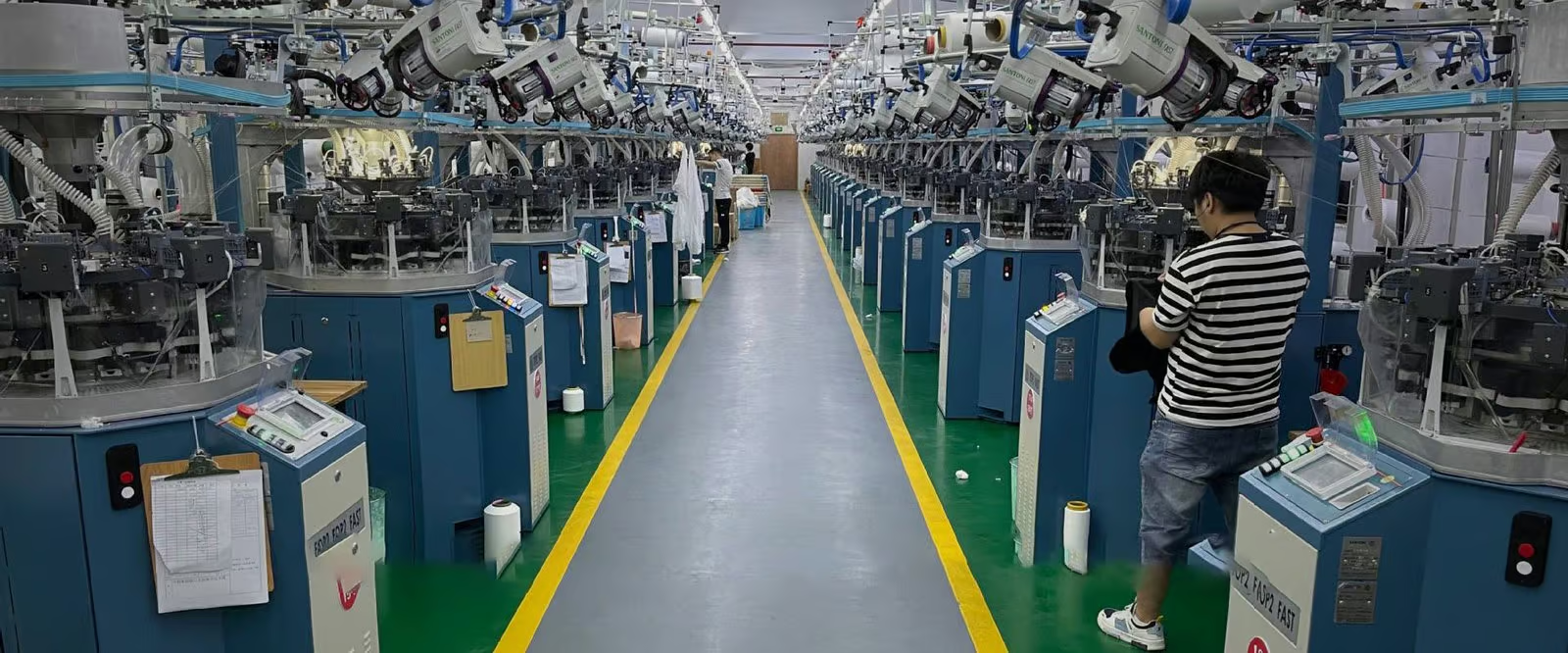
Italian Santoni seamless knitting machines in MOVEVOX's Yiwu activewear production base

MOVEVOX core seamless manufacturing capability in Yiwu, Zhejiang, China.

28Santoni seamless machines
5–10working days for standard sampling after details are confirmed
100 / 150pcs regular custom MOQ reference: seamless / cut-and-sew
150K–200Kpcs/month managed stable delivery capacity
DIRECT ANSWER

What Is a Custom Leggings Manufacturer?

A custom leggings manufacturer should do more than supply an existing style with a new logo. For established brands, customization can involve fabric, fit, waistband construction, measurements, colors, seams, branding, labels, packaging and production standards, followed by sample approval and controlled reproduction in bulk.

Product Development, Not Decoration

A real custom program starts from a Tech Pack, authorized reference sample, sketch, image or clear product requirement and converts that input into a manufacturable specification and physical sample. See MOVEVOX's product development workflow for the broader development system.

Manufacturing Route Matters

Leggings may be developed through seamless knitting or cut-and-sew construction. The correct route depends on structure, fit, material, pockets, panels, texture, compression zones and other design requirements. Buyers can also review the dedicated leggings product category.

Approval Before Bulk

The objective is not simply to make an attractive first sample. Measurements, material, workmanship, color, branding and packaging need defined approval standards before bulk production begins.

Built for Repeatability

For growing and established brands, the supplier must also support repeat orders, additional colors, multiple SKUs and increased quantities without rebuilding the development standard for every order.

Procurement takeaway: The buying decision is not only whether a factory can make leggings, but whether it can develop, document and repeatedly manufacture your approved product through a controlled custom manufacturing system.
WHO THIS IS FOR

Who This Manufacturing Program Is Built For

MOVEVOX is best aligned with brands and B2B buyers that need repeatable product development, formal sample approval and a manufacturing partner capable of supporting both initial validation and later production growth.

Established Activewear Brands

You may already have technical specifications, preferred materials, established size charts and internal product approval standards. Your priority is less about finding the lowest advertised MOQ and more about finding a supplier that can interpret your technical requirements, maintain approved specifications, manage quality through bulk production and provide a clear production responsibility chain.

  • Existing Tech Packs and measurement charts already available
  • Repeat orders require consistent specifications across production cycles
  • Product and sourcing teams need one accountable project interface
  • Seamless and cut-and-sew styles may exist within one collection
SUPPLIER FIT CHECK

Where Does Your Leggings Project Fit?

Different projects require different supplier inputs. Select your current stage to identify what MOVEVOX needs from you and what the next practical manufacturing step should be.

Concept

You have a clear product direction but do not yet have a production-ready specification. MOVEVOX can review intended use, target fit, visual direction, material preference and branding requirements, then identify which areas still need technical definition. Concept-led development requires active customer approval because MOVEVOX translates the product direction into manufacturing inputs rather than independently defining the customer's brand positioning.

You provide
  • Target product use and intended customer profile
  • Reference images, sketches or authorized sample direction
  • Target quantity, launch date and commercial priorities
MOVEVOX provides
  • Initial manufacturability and production-route review
  • Material, construction and development questions
  • Defined next steps toward sample development
PROCUREMENT RISK

Six Supplier Risks Worth Checking Early

Custom leggings failures often begin before sewing or knitting starts. Mature buyers should examine how a manufacturer controls specifications, materials, production location, fit, capacity and quality before moving a supplier into the shortlist.

01

Sample-to-Bulk Drift

A good development sample does not guarantee consistent bulk execution. Risk increases when the approved sample, final measurement chart, materials, colors, branding or packaging are not translated into a controlled production standard.

Verify: Ask how approved samples, specifications and first-article checks are transferred into bulk production.

02

Wrong Production Route

A seamless design and a cut-and-sew design do not solve the same engineering problem. Selecting a route only because equipment is available can restrict pockets, panels, textures, fit or construction unnecessarily.

Verify: Ask why the supplier recommends seamless, cut-and-sew or another route for your exact structure.

03

Uncontrolled Material Changes

A fabric with the same general composition can still differ in weight, hand feel, stretch, recovery, color or finishing. Unapproved material substitution can therefore change fit and performance even when the fiber label looks similar.

Verify: Ask how approved material references and incoming production lots are compared before use.

04

Hidden Production Transfers

Production may move when capacity becomes tight. Without a controlled production-site assignment, document transfer and quality verification, a buyer can approve one facility while actual manufacturing occurs somewhere else.

Verify: Ask who controls production-site changes and whether buyer approval is required for your program.

05

Fit Version Confusion

Leggings depend on the interaction of measurement, fabric elasticity, recovery and body fit. Old measurement files or unapproved pattern revisions can create waist, hip, rise or inseam differences across production.

Verify: Ask which pattern, program, measurement chart and approved sample version controls the current PO.

06

Capacity Without Quality Release

Machine output is not the same as shippable capacity. A supplier may quote theoretical production without considering style complexity, QC workload, material readiness, packing or final inspection requirements.

Verify: Ask for stable delivery capacity and how quality release is included in capacity planning.

CORE MANUFACTURING

How MOVEVOX Turns Leggings Requirements Into Controlled Production

MOVEVOX combines product development, seamless knitting, cut-and-sew production, quality control and managed capacity so buyers can develop and scale leggings through one accountable manufacturing system.

Two Manufacturing Routes Under One Development Responsibility

Custom leggings are not one manufacturing problem. A seamless style may depend on yarn selection, machine compatibility, knitted structure, density, rib, mesh, jacquard or zoned compression. A cut-and-sew style instead depends on fabric selection, pattern engineering, cutting, seam construction, pockets, panels, gussets, waistband construction and measurement control.

MOVEVOX's own production system includes 28 Italian Santoni seamless knitting machines and approximately 24 principal sewing and garment-making machines. The chosen route is based on product structure and development requirements rather than a blanket claim that one method is always superior.

For a deeper view of the operating model, review MOVEVOX manufacturing capabilities.
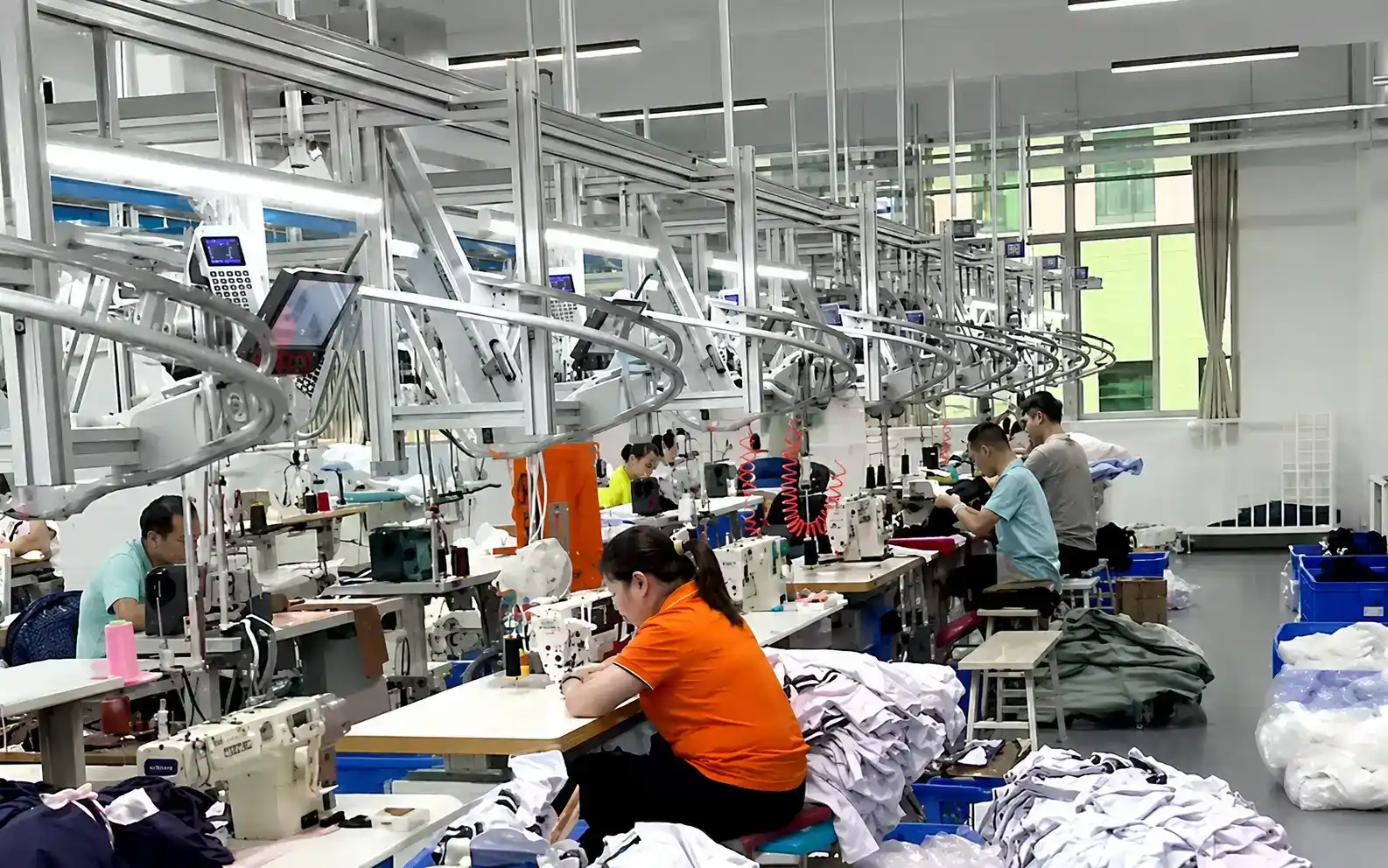
MOVEVOX cut-and-sew activewear production area with garment sewing equipment

Development, Quality and Scale Stay Under One Responsibility Chain

MOVEVOX's own factory acts as a development, sample, core production and quality-control center. The product development system is normally staffed by about eight people, while the current QC organization includes five QC personnel. Standard samples typically require about 5–10 working days after development details are confirmed.

For larger or repeat orders, MOVEVOX can add capacity through eight long-term satellite factories—six in Yiwu and two in Guangzhou. Satellite facilities work from MOVEVOX-issued technical information, approved standards, material requirements and quality expectations; they do not independently redefine customer specifications.

MOVEVOX does not position the network as “100% everything in one workshop.” The value is controlled allocation, common technical standards, one customer-facing responsibility chain and quality release managed through MOVEVOX.
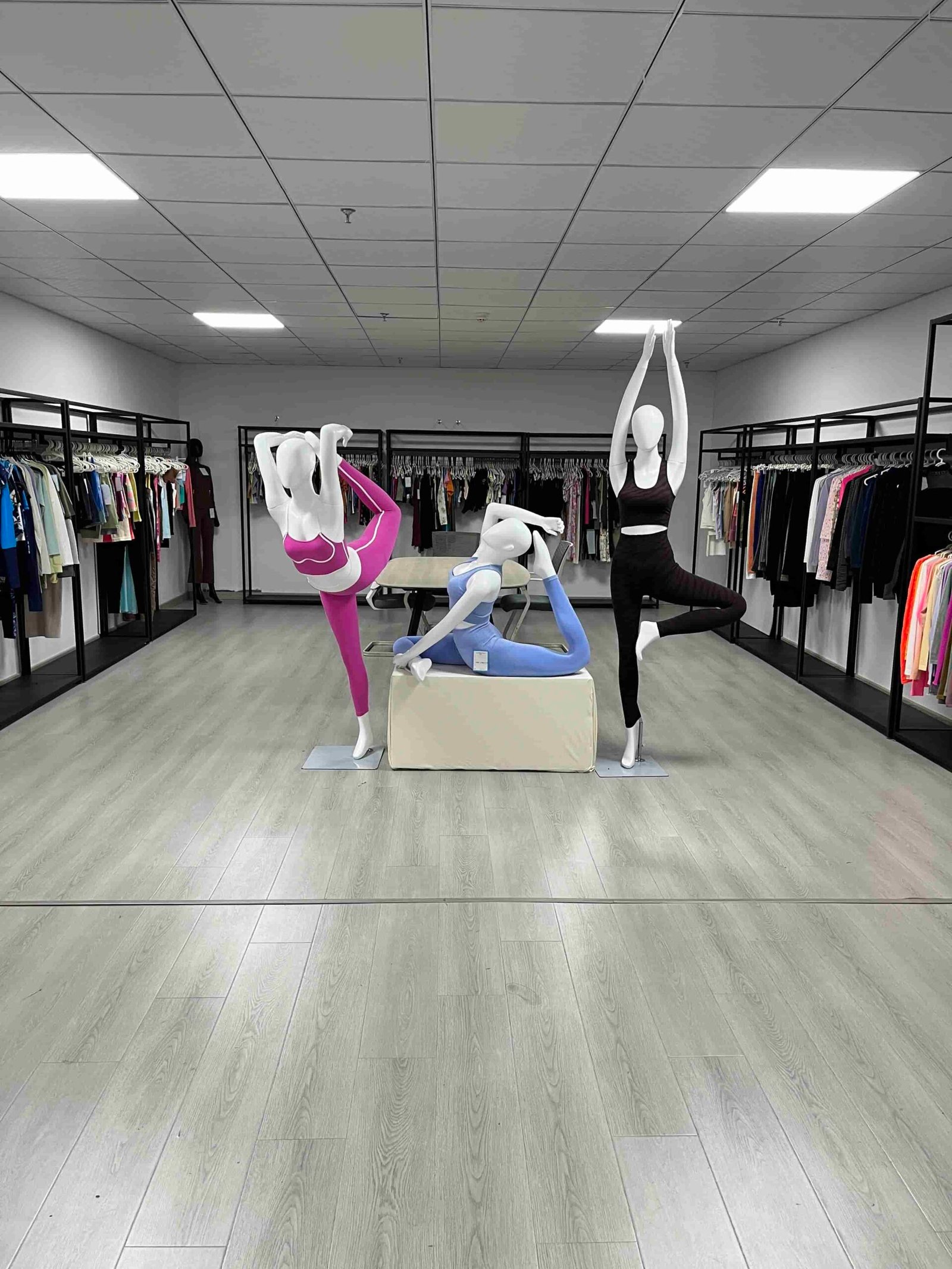
MOVEVOX activewear sample development area with garments and development work in progress
DEFINED OPERATING NUMBERS

Key Numbers Behind MOVEVOX Manufacturing Capability

These figures are procurement reference points, not promotional maximums. Each number has a defined operating scope and should be evaluated together with product complexity, materials and order requirements.

28Santoni seamless machines
≈24principal sewing and garment-making machines
5QC personnel
≈6,000 m²core manufacturing base
5–10 daysstandard sampling after details are confirmed
150K–200Kpcs/month managed stable delivery capacity
Data scope: The 150K–200K pcs/month figure describes managed stable delivery capability across own and controlled resources, not a theoretical maximum machine-output calculation. For the broader supplier profile, see Why MOVEVOX.
MANUFACTURING ROUTE

Seamless or Cut-and-Sew: Which Route Fits Your Leggings?

Neither method is automatically better. The correct choice depends on product structure, fit, visual design, material strategy, pockets, panels, knitted zones and how the brand intends to validate the product.

Decision AreaSeamless RouteCut-and-Sew Route
Core constructionTubular or engineered knitted structure with reduced conventional seamsFabric panels are cut from patterns and assembled through defined seam construction
Design strengthRib, mesh, jacquard, texture and zoned knitted structuresPanels, pockets, gussets, shaped seams and mixed-material constructions
Compression approachYarn, knitting density and zoned structure can create localized supportFabric recovery, negative ease, layering and panel design can create support
Pocket flexibilityPossible only where structure and construction allowMore flexible for side, waistband and panel-integrated pocket constructions
Material basisYarn specification and knitting program are primary controlsFinished fabric specification, direction and cutting behavior are primary controls
Fit developmentKnit program, yarn behavior, size and body interaction must be validated togetherPattern, grading, fabric stretch, rise, waist and hip balance must be validated together
MOQ baselineRegular custom projects start around 100 piecesRegular custom projects start around 150 pieces
Best decision ruleUse when knitted engineering supports the intended designUse when pattern and panel construction better support the intended design
Explore MOVEVOX seamless activewear for a deeper view of the seamless manufacturing route.
WAISTBAND ENGINEERING

Engineer the Waistband Before You Judge the Style

Waistband performance depends on height, waist opening, hip relationship, rise, material recovery and construction. A visually “high-waisted” design can still roll, slide or feel restrictive if these variables are not developed together.

MOVEVOX supports both seamless integrated waistbands and cut-and-sew layered or panelled waistbands. Final structure is validated through sample fit, waist and rise measurements, symmetry, roll or twist observation and material recovery before bulk standards are locked. See the broader leggings product page for product context.
OPACITY EVIDENCE

What Actually Controls Opacity in Stretch Leggings?

MOVEVOX treats opacity as a product-level result affected by material density, color, weight, stretch, fit and garment structure. “Squat-proof” should therefore be validated under defined project conditions rather than used as an unconditional claim.

Material Density

Claim to evaluate: Higher coverage begins with an appropriate material structure.

GSM alone cannot predict opacity. Fiber, yarn, knitting density, finishing and actual extension all influence how much light passes through the material when worn.

Evidence basis

Material specification, GSM check and project-level opacity evaluation under stretch.

Color Effect

Claim to evaluate: Light colors generally require more careful opacity validation.

Black and other dark colors often provide easier visual coverage than white, pale pink, fluorescent or other light shades. Each intended color needs evaluation with the selected material and target fit.

Evidence basis

Approved color sample and opacity comparison under defined viewing conditions.

Stretch State

Claim to evaluate: Static fabric appearance does not represent worn-legging coverage.

Material that looks opaque when relaxed can become more transparent when stretched around the hips or during deep flexion.

Evidence basis

Stretch-state sample inspection and buyer-defined test protocol where required.

Fit and Size

Claim to evaluate: Excessive negative ease can reduce otherwise acceptable coverage.

Sizing, hip relationship and pattern or knitted dimensions determine how far the fabric must extend on the body.

Evidence basis

Measurement specification, Fit Sample and defined size validation.

Garment Structure

Claim to evaluate: Construction determines where high-stretch and coverage risks concentrate.

Seams, gussets, knitted zones and local structures can alter stretch distribution. A single fabric certificate does not prove every finished style will behave identically.

Evidence basis

Approved garment sample plus incoming and finished-product opacity checks.

FIT ENGINEERING

Waist-to-Hip Fit Is More Than a Size Label

MOVEVOX develops against the customer's measurement chart, POM definitions, target fit and material behavior. Size names such as XS, M or XL are labels; the actual garment is controlled by measurable specifications and approved fit.

SizeWaist POMHip POMInseamFit ValidationProduction Basis
XSBuyer specificationBuyer specificationBuyer specificationSize Set / project needApproved grade rule
SBuyer specificationBuyer specificationBuyer specificationSize Set / project needApproved grade rule
MBuyer specificationBuyer specificationBuyer specificationBase Fit / project needApproved base specification
LBuyer specificationBuyer specificationBuyer specificationSize Set / project needApproved grade rule
XLBuyer specificationBuyer specificationBuyer specificationSize Set / project needApproved grade rule
DEFECT PREVENTION

Common Leggings Failures Should Be Prevented Before Final Inspection

Most failures are not caused by one isolated workmanship issue. They often reflect interactions between material, fit, structure, production control and approved specifications, so prevention must begin before bulk production.

DefectLikely CausePreventionInspection PointCorrective Action
Waistband rolling or slippingWaist opening, rise, recovery or waistband construction does not match intended body fit.Validate waistband height, opening dimensions and material recovery during Fit Sample development.Fit Sample, first article and finished-garment checks.Hold affected output, review measurements and construction, correct the process, then re-inspect.
Excessive transparencyColor, fabric density, GSM, stretch level or garment sizing creates insufficient coverage under extension.Evaluate selected material and color under intended stretch conditions before bulk approval.Incoming material, approved sample and finished garment under defined conditions.Segregate affected material or garments and re-evaluate material, sizing or production configuration.
Seam failure or skipped stitchesNeedle, thread, stitch construction or tension does not match garment elasticity and stress.Confirm seam construction on representative material and high-stress locations before bulk starts.First article, inline inspection and finished-garment workmanship checks.Stop the affected operation, adjust settings, repair eligible pieces and re-inspect.
Measurement driftIncorrect pattern, program, cutting, handling stretch or uncontrolled process variation changes critical POM.Freeze current specification and align measurement method before production release.First article, inline measurement sampling and final measurement inspection.Identify trend, isolate affected quantities, correct the source and increase screening where necessary.
Contour misalignmentGlute lines, knitted zones, seams or panels shift because of pattern, program, cutting or assembly variance.Establish approved visual position and symmetry in the sample and first article.First article, inline visual checks and finished-garment symmetry inspection.Hold affected output, correct positioning and re-inspect before packing.
Label or packing mismatchSKU, size, color, barcode or packing information is mixed during finishing or packing.Lock packing requirements and identify product variants clearly before packing starts.Label application, individual packing and carton-level final checks.Segregate the affected batch, reconcile identifiers and re-check packed units before shipment release.
MATERIAL DECISION TREE

Choose Leggings Materials by Product Objective, Not Composition Alone

Fabric selection starts with the wearing experience and construction target. Composition, GSM, stretch, recovery, surface finish, opacity, manufacturing route and custom-color requirements must then be reviewed together.

What wearing feel do you want?

SoftSmoothStructuredFirm

How much support is required?

LightModerateCompression-oriented

Which manufacturing route applies?

Cut-and-SewSeamlessReview Needed

What color route is required?

Stock ColorPantone CustomTo Be Confirmed

Naked-Feel Direction

Reference development commonly uses approximately 75–82% nylon and 18–25% spandex at around 200–240 GSM. Final selection still depends on target hand feel, opacity, stretch and the approved material sample.

200–240 GSMHigh StretchSoft Hand

Compression Direction

Reference development is approximately 65–78% nylon/polyester with 22–35% spandex at around 230–320 GSM. These are development ranges, not a fixed formula for every product.

230–320 GSMStrong RecoverySupportive Fit

Brushed Direction

Reference development commonly uses approximately 75–82% nylon/polyester with 18–25% spandex at around 210–270 GSM. Pilling risk, surface consistency, recovery and hand feel need separate approval.

210–270 GSMBrushed SurfaceSeasonal Use

Seamless Yarn Direction

Reference yarn systems can use approximately 80–94% nylon/polyester with 6–20% spandex, but performance also depends on knitting structure, density, machine settings and localized program design.

Yarn BasedSantoni RouteStructure Driven
MATERIAL PERFORMANCE

Stretch and Recovery Must Be Evaluated Together

High stretch alone does not guarantee good leggings performance. Material recovery affects knee bagging, waistband stability, shape retention and repeat fit, while final behavior also depends on garment dimensions, construction and repeated use.

Naked Feel

A naked-feel development direction combines high stretch with a soft, smooth hand. MOVEVOX's reference range is typically 200–240 GSM with about 18–25% spandex. Recovery still needs material-level and sample-level verification before approval.

Compression

Compression-oriented development normally prioritizes stronger recovery and supportive containment over the lightest possible hand. MOVEVOX's reference range is approximately 230–320 GSM with about 22–35% spandex, subject to final material, fit and customer-defined performance requirements.

Brushed

Brushed materials can provide a softer surface and seasonal wearing direction, but brushing changes surface behavior and can introduce additional pilling or appearance risks. Stretch and recovery therefore need evaluation together with the final approved finish.
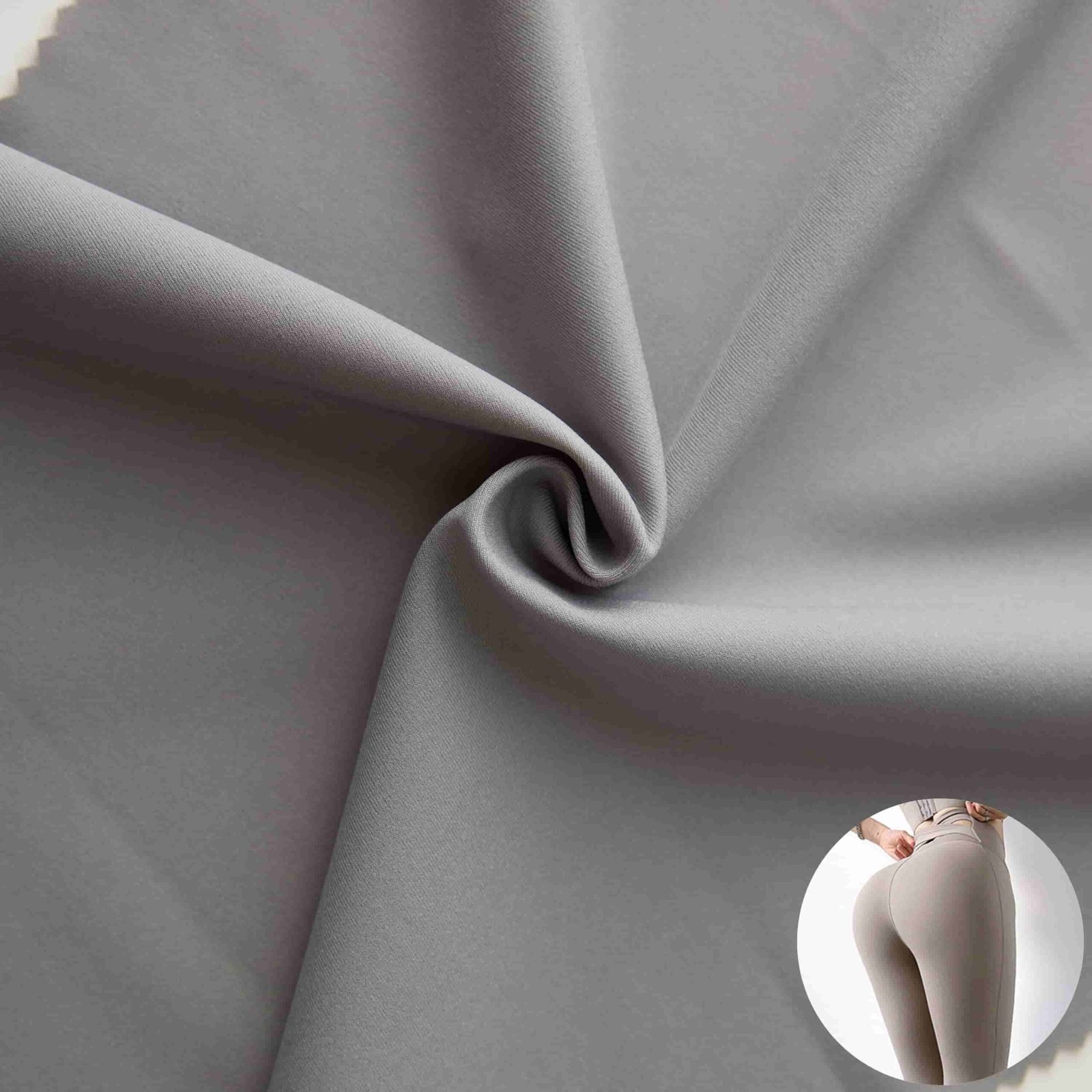
MOVEVOX smooth high-stretch activewear fabric sample used for leggings material evaluation

Performance Dimensions to Verify

StretchRecoverySupportHand FeelOpacitySurface

No fabricated radar score is shown. Numeric scoring should be populated only from the selected material code, approved sample or agreed test method.

FABRIC COMPARISON

Compare Fabric Routes Before Locking Your Leggings Specification

These figures are MOVEVOX development-reference ranges rather than final material specifications. The production standard should always return to the approved material code, supplier specification, sample and buyer-required testing.

ParameterNaked FeelBrushedCompressionHigh Stretch
Reference composition75–82% nylon / 18–25% spandex75–82% nylon/poly / 18–25% spandex65–78% nylon/poly / 22–35% spandex70–85% nylon/poly / 15–30% spandex
GSM reference200–240210–270230–320180–280
Stretch directionFour-way, highFour-way, medium-highFour-wayFour-way, high
Recovery reference92–96%+90–95%+92–97%+90–96%+
Hand feelSoft, smoothSoft, brushedFirm, supportiveDepends on finish
OpacityProject validationProject validationProject validationProject validation
PillingTest if requiredHigher attentionTest if requiredTest if required
Best useYoga / PilatesSeasonal leggingsCompression trainingGeneral active leggings
Composition and GSM alone should not determine the final choice. Confirm hand feel, opacity under intended stretch, recovery, color, wash behavior and fit using the actual material and garment sample. For further technical reading, see MOVEVOX Fabric Guides.
COLOR DEVELOPMENT

Control Custom Color Before It Reaches Bulk Production

Color development needs a reference, material route, approval standard and production-lot control. Colorfastness requirements are separate and should be selected according to market, use, color and buyer standards.

Color Reference

Pantone-referenced activewear color development swatches used by MOVEVOX

Begin with a defined Pantone reference, customer physical color sample or another approved standard.

Material Review
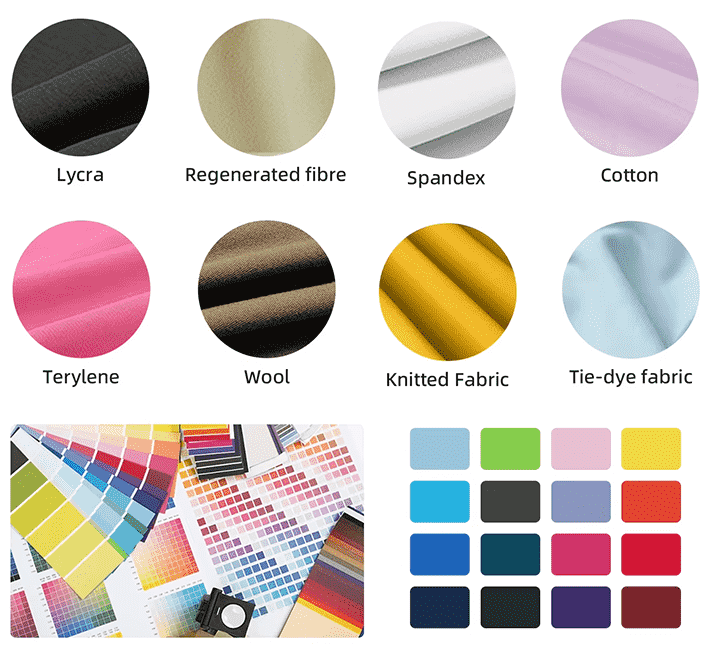
Approved activewear fabric and yarn color references used for MOVEVOX material development

Confirm fabric or yarn route because fiber type, knitting structure, GSM and finishing can change color appearance.

Lab Dip

Laboratory dip samples showing multiple shade variations for custom color selection

For custom dyeing, a Lab Dip or comparable development sample establishes a physical approval reference when applicable.

Light Review

D65 light box used to evaluate activewear color matching under controlled lighting

Review the candidate shade against the agreed standard under controlled viewing conditions.

Color Approval

Approved master fabric color swatch archived as a production reference

The approved color reference becomes part of the production standard together with the material specification.

Bulk Shade & Fastness

Textile laboratory crocking test equipment used for colorfastness evaluation

Production lots are compared with the approved standard. Applicable wash, rubbing, perspiration or other testing is selected according to buyer requirements.

A passing result for one material, color or batch does not automatically cover every future color. Color appearance and colorfastness evidence must remain tied to the actual configuration being supplied.
PRODUCT DEVELOPMENT

From Product Requirement to Bulk-Ready Leggings Specification

MOVEVOX uses development to convert the buyer's design intent into measurable, manufacturable and approvable standards. Each stage has a defined output so the project can move from concept or Tech Pack toward controlled bulk production.
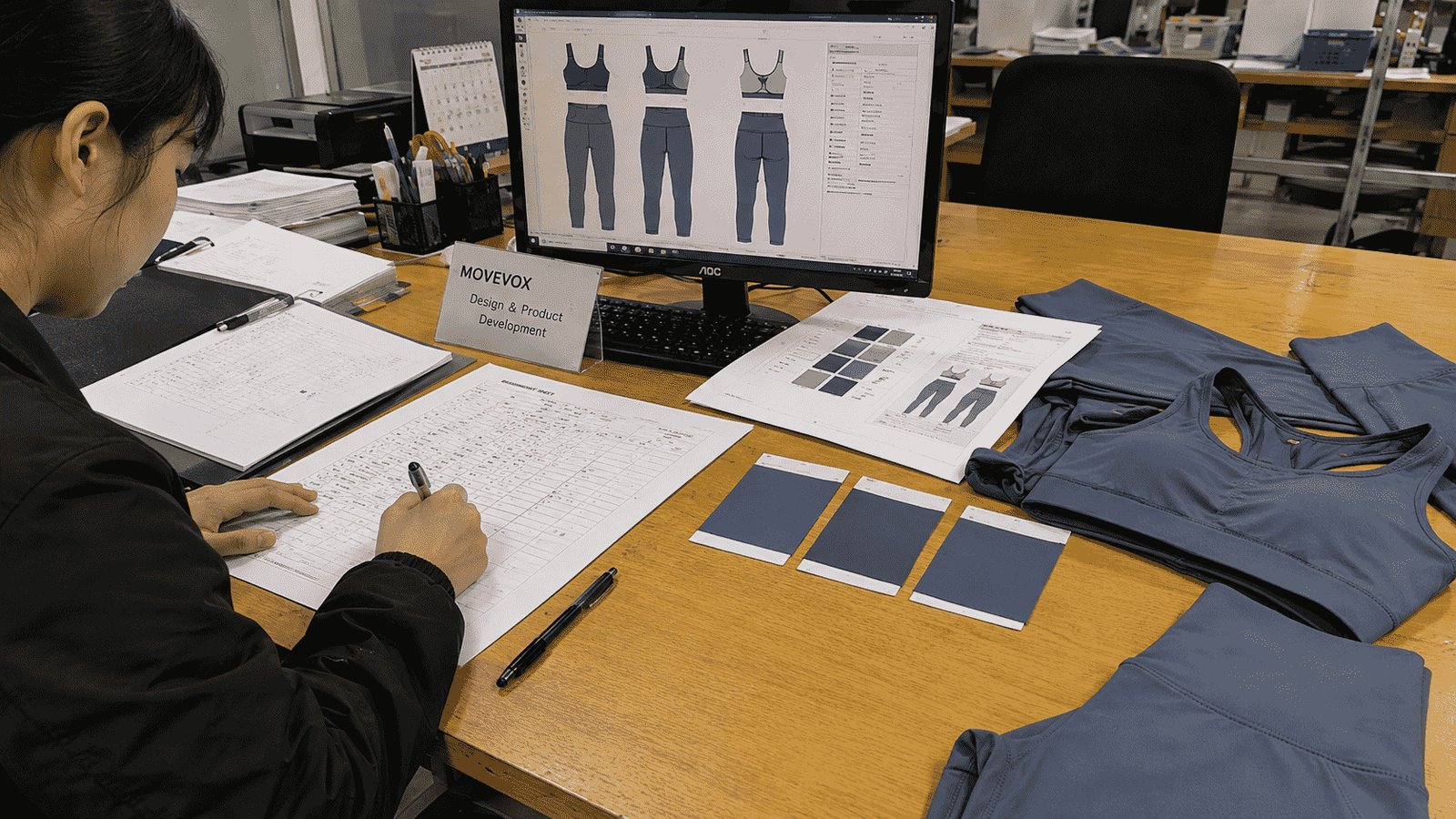
MOVEVOX Tech Pack review with pattern, fabric swatches and multiple activewear sample versions
01

Project Brief

Review product objective, target customer, activity, quantity, colors, size range, technical input and target date.

Deliverable: Development Brief
Time: Project-specific

02

Tech Review

Check available Tech Packs, measurement charts, sketches, authorized samples and branding requirements for missing information or manufacturing risks.

Deliverable: Open Points
Time: Project-specific

03

Material Route

Evaluate fabric or seamless yarn direction against hand feel, stretch, recovery, opacity, color, construction and MOQ requirements.

Deliverable: Material Direction
Time: Project-specific

04

Pattern / Program

Cut-and-sew projects use pattern development; seamless projects require knitting-program and structure development.

Deliverable: Development Version
Time: Project-specific

05

Sample

Create the first physical version and check measurements, structure, workmanship and visible issues before buyer review.

Deliverable: Sample
Time: typically 5–10 working days after details are confirmed

06

Fit Approval

Translate buyer feedback into controlled revision actions and confirm fit, measurements, material behavior and major construction.

Deliverable: Approved Fit
Time: Feedback-dependent

07

Bulk Standard

Consolidate final Tech Pack, measurements, approved or PP sample, color, branding, labels and packaging requirements.

Deliverable: Production Standard
Time: Project-specific

08

Bulk & QC

Begin production after readiness checks, then use first-article, in-line, finished-garment and final controls against approved standards.

Deliverable: Released Bulk
Time: generally 20–35 days under normal conditions

DEVELOPMENT INPUT

What to Prepare Before Developing Custom Leggings

A complete Tech Pack speeds technical review, but MOVEVOX can also start from an authorized sample, sketch, image or structured concept. The clearer the input, the fewer assumptions are required during development.

Required

Style Drawing

Provide technical flats, sketches or clear product views showing the intended front, back and major construction. If drawings are incomplete, identify which visual elements are essential and which can be developed with MOVEVOX.

Recommended

Measurement Chart

Define key POM, unit, measurement method, tolerance and grade logic where available. Unclear measurement relationships must be resolved before fit can be locked.

Recommended

Fabric Requirement

Provide composition, GSM, hand feel, stretch, recovery, finish, color and functional expectations where known. If no final fabric is selected, MOVEVOX can propose development directions for buyer review.

Recommended

Color Standard

Pantone references, physical swatches or existing approved products can guide color development. Identify core and seasonal colors and whether stock-color or custom-dye routes are acceptable.

Required

Brand Artwork

Provide authorized logo artwork, size, placement and intended process. Logo construction may affect sampling, MOQ, cost and lead time, particularly when molds, jacquard, embroidery or special materials are involved.

Recommended

Label Details

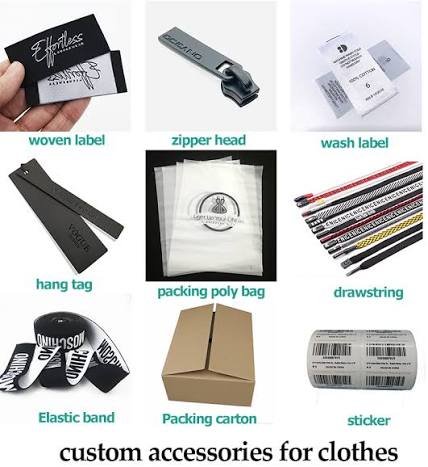
Main labels, care labels, size labels, woven labels and hangtags should include artwork and content requirements. Market-specific legal or care information remains subject to the customer's applicable requirements.

Recommended

Packaging Details

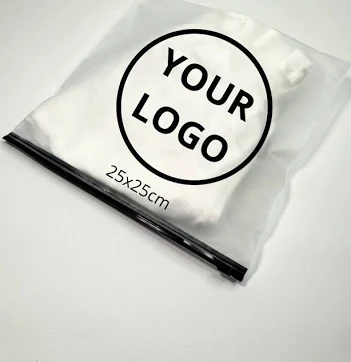
Specify individual bags, stickers, barcodes, inserts, carton marks and other retail or warehouse requirements. SKU-specific identification is especially important in multi-color and multi-size programs.

Required

Order Plan

Provide approximate quantity, color breakdown, size range, target launch date and destination. These inputs affect MOQ, material sourcing, capacity planning, costing and the recommended manufacturing path.

If some inputs are incomplete, MOVEVOX can identify the missing technical questions during project review. Unresolved items remain open until both sides confirm the required standard; missing buyer decisions are not silently replaced with assumptions.
SAMPLE APPROVAL SYSTEM

Each Sample Stage Should Answer a Different Question

Sampling is an approval system, not a single prototype event. Different samples validate structure, fit, size or production readiness, and one approval should not be interpreted as approval of every product variable.

01

Development Sample

The first physical sample converts confirmed development input into something that can be measured, worn and technically reviewed. It is intended to reveal structure, proportion, material and manufacturability issues early.

Buyer inputs: confirmed brief, material/color/construction direction. MOVEVOX outputs: first pattern or seamless-program sample and internal review. Pass criterion: major structure is manufacturable and remaining issues are clearly identified.

02

Fit Sample

The Fit Sample focuses on base-size proportions, POM, rise, waist-to-hip relationship, containment and movement. For stretch leggings, fit must be evaluated together with actual or representative material behavior.

Pass criterion: base fit and major product proportions meet the customer's target before grading continues.

03

Revised Sample

Buyer comments are converted into controlled changes rather than informal factory adjustments. The revised sample confirms whether the agreed corrections have solved the issues identified in the previous review.

Pass criterion: requested corrections are resolved and no new critical issue prevents progression.

04

Size Set

Where the project requires size validation, selected graded sizes are checked to confirm that approved fit logic has transferred through the size range rather than simply scaling every measurement proportionally.

Pass criterion: size progression remains consistent with approved measurement and fit requirements.

05

PP Sample

The pre-production sample is used to lock the bulk reference after major product elements have been finalized. It should represent the approved materials, construction, branding and other production requirements as agreed for the program.

Pass criterion: required production variables are approved and the project is ready for controlled bulk release.

SAMPLING MILESTONES

How the Standard 5–10 Day Sample Window Works

Standard sample development is typically about 5–10 working days after the required development details are sufficiently confirmed. That timing is not a universal promise for every material, color or construction.

01

Details Confirmed

Sampling timing begins only after the project has enough confirmed information to proceed. Open material, measurement, construction, artwork or color questions can delay the effective development start.

02

Material Ready

Existing fabric or yarn can support a faster start. Custom dyeing, special material sourcing or custom seamless yarn may require separate material lead time before physical sampling proceeds.

03

Pattern or Program

Cut-and-sew styles move through pattern work, while seamless styles require knitting-program and structural development. Complexity differs by product rather than following one fixed daily schedule.

04

Sample Making

The physical garment is produced using the confirmed development version. Product structure, material, logo or special finishing can influence time within the normal sample-development window.

05

Internal Review

Before dispatch, the sample is checked against relevant measurements, workmanship, structure and visible requirements. Issues identified internally may be corrected before buyer review.

06

Sample Ready

Once the sample has passed the required internal review, it is prepared for buyer evaluation or shipment. International courier transit is separate from the factory's sample-development timing.

The 5–10 working-day reference applies to standard sample development after details are confirmed. Custom-dyed materials, special processes, complex revisions, buyer feedback and international transit can extend total calendar time.
APPROVAL GATE

Sample Approval Key Takeaways

A buyer's “approved” decision should be specific enough for production teams and QC to know exactly what has been locked and what remains open.

Fit Approval Is Not Total Approval

Confirmed fit does not automatically approve every color, size, label, package or production process used later.

Measurements Need a Controlled Version

The final approved chart, POM definitions, measurement method and buyer tolerance should be identifiable before bulk production.

Material Approval Must Stay Specific

Composition alone does not define hand feel, stretch, recovery, GSM, opacity or color; the actual approved material reference matters.

Branding Needs Its Own Approval

Logo process, size and position, labels and hangtags should match approved artwork and placement.

Packaging Is Part of the Specification

Bags, stickers, barcode information, carton marks and SKU identification should be approved where they affect commercial execution.

Open Points Must Close Deliberately

Any unresolved item should remain visible until approved instead of being silently interpreted as a factory decision.

SAMPLE-TO-BULK CONTROL

How an Approved Sample Becomes a Bulk Production Standard

Bulk consistency comes from converting approval into controlled specifications. MOVEVOX uses the final technical version and approved references as production inputs rather than asking bulk teams to reproduce the sample from memory.

Approved Sample Side

Final Tech Pack, measurement chart, approved or PP sample, material/color reference, logo artwork, labels and packaging define what the buyer has approved.

Bulk Execution Side

Production readiness, first article, inline checks, finished-garment inspection and final release compare execution back to those approved references.

Measurements

Bulk measurements are checked against the approved measurement specification and defined tolerance rather than visual appearance alone.

Material

Production materials are reviewed against approved requirements for composition, color, GSM, stretch and other applicable control points.

Color

Production shade is compared with the approved color reference; custom colors may also require Lab Dip or production-lot confirmation.

Construction

Seam type, knitted structure, waistband, gusset, pockets and other construction details return to the approved technical requirement.

Branding

Logo process, size and position, labels and hangtags are produced against approved artwork and placement standards.

Packaging

Individual packaging, SKU identification, stickers, barcodes and carton information are checked against the final packing requirement.

The objective is controlled consistency within approved specifications and tolerances—not an unrealistic claim of zero production variation.
PRIVATE LABEL EXECUTION

Private Label Means More Than Adding Your Logo

MOVEVOX can coordinate product, material, color, fit, construction, branding, labels and packaging within one development process. Each element has its own approval requirements and may have different MOQ or lead-time implications.

Fabric

Fabric can be selected from available material resources or developed toward a defined composition, weight, hand feel, stretch, recovery, finish and product use. Custom materials and specialized finishes can introduce supplier-level MOQ or additional sourcing time separate from the base garment MOQ.

MOQ STRUCTURE

Understand the Effective MOQ Before You Plan the Order

MOVEVOX's base garment MOQ is only the first layer. Materials, custom colors, logo processes, labels, packaging, SKU allocation and supplier minimums can all change the effective starting quantity.

Validation

Pilot Order

A normal custom starting point is approximately 100 pieces per seamless style or 150 pieces per cut-and-sew style when the project uses materials and processes compatible with those base quantities.

Quantity: ≈100 seamless / ≈150 cut-and-sew baseline
Color/size logic: Review by style, color and size breakdown
Price factors: Material, construction, branding, packaging, quantity

Scale

Scale Program

For validated products entering larger or repeat quantities, MOVEVOX reviews capacity, material availability, production-site allocation, QC workload and delivery timing before confirmation.

Quantity: Confirmed through project-specific capacity review
Color/size logic: Based on actual sales and replenishment planning
Price factors: Volume, material booking, capacity and delivery structure

MOQ note: Custom dyeing commonly requires evaluation around one dye lot, which can translate to approximately 400–600 finished pieces per color depending on material and product structure. Garment MOQ and material MOQ are therefore not always the same.
PROJECT REVIEW

Ready to Review Your Custom Leggings Project?

Send your Tech Pack, measurement chart, authorized reference sample details or product concept together with target quantity and launch timing. MOVEVOX can review the manufacturing route, development inputs, likely MOQ considerations and practical next step before sampling begins.

Project files can be reviewed before you commit to sample or bulk production.

BULK EXECUTION

Bulk Production Runs Through Defined Quality and Release Gates

MOVEVOX treats bulk production as a controlled chain rather than a hidden factory process. Each stage has required inputs, production responsibility, quality checkpoints and conditions that must be resolved before the next stage proceeds.

01

Production Ready

Final specification, approved sample, materials, color, branding, packing requirements and production assignment are reviewed before bulk release.

Owner: Order Team
QC Gate: Readiness Review

02

Material Control

Incoming materials are checked against applicable project requirements before use, including composition reference, color, GSM, shrinkage, elasticity, opacity and other relevant specifications.

Owner: Purchasing / QC
QC Gate: Material Release

03

First Article

Initial production output is checked to confirm current materials, measurements, workmanship, construction, logo placement and other critical requirements.

Owner: Production / QC
QC Gate: First Article

04

Bulk Production

Approved production standards are used by the assigned facility. Seamless and cut-and-sew projects follow different manufacturing controls while remaining linked to the same approved project information.

Owner: Production
QC Gate: Approved Standard

05

Inline Control

QC checks production while work is still in progress so measurement trends, workmanship issues or process deviations can be identified before an entire order is completed.

Owner: QC
QC Gate: Inline Check

06

Finished Garment

Completed garments are reviewed for applicable dimensions, construction, appearance, branding, labels and other product requirements before release preparation.

Owner: QC
QC Gate: Garment Check

07

Final Inspection

Final inspection follows buyer requirements where specified, including customer AQL or QC standards when provided. Failed conditions require hold, correction and re-inspection before release.

Owner: QC
QC Gate: Final Release

08

Packing & Shipment

Approved pieces are packed according to confirmed requirements. SKU, label, barcode, carton and shipment information are checked before cargo release.

Owner: Order / Logistics
QC Gate: Shipment Release

CAPACITY GOVERNANCE

Capacity Means Quality-Released Garments, Not Machine Output

MOVEVOX defines capacity around stable managed delivery rather than adding theoretical machine maximums. Actual project capacity depends on construction, SKU mix, materials, production allocation, quality workload and delivery requirements.

28

Santoni Machines

Own-factory seamless capacity is built around 28 Italian Santoni machines used for seamless development and production.

≈24

Cut-and-Sew Machines

The core factory has approximately 24 principal sewing and garment-making machines supporting cut-and-sew products.

8

Satellite Facilities

MOVEVOX coordinates eight long-term satellite factories: six in Yiwu and two in Guangzhou.

≈6,000 m²

Core Operating Space

The Yiwu core manufacturing base has approximately 6,000 square meters of operating space across manufacturing and supporting functions.

150K–200K pcs/month

Managed Stable Capacity

Normal combined managed stable delivery capacity is approximately 150,000–200,000 pieces per month across own and controlled production resources.

Project Capacity Still Requires Review

The 150K–200K figure is not a theoretical maximum-output claim. Formal capacity for a leggings program depends on seamless or cut-and-sew route, style complexity, number of SKUs, material availability, packing workload, quality requirements and production-site allocation.

CONTROLLED PRODUCTION NETWORK

One MOVEVOX Responsibility Chain Across Controlled Production Capacity

MOVEVOX uses its own Yiwu factory as the technical and quality-control center and adds long-term satellite facilities for suitable bulk work. Buyers do not need to separately manage each production resource.

MOVEVOX production network diagram connecting the core factory, satellite factories and specialist processes through project, PMC and QC management

Core Factory

The Yiwu core factory handles development, samples, key production, process establishment, first-article work, higher-risk styles, quality control and problem closure. It establishes the standard before suitable production is expanded.

Yiwu Satellites

Six long-term satellite facilities in Yiwu provide additional production capacity and support WIP checks, first-article verification, rework follow-up and urgent coordination where required.

Guangzhou Satellites

Two long-term satellite facilities in Guangzhou add specialist and flexible cut-and-sew capacity. Allocation depends on style structure, capability, order size, schedule and buyer requirements.

Yarn & Fabric

MOVEVOX coordinates yarn, fabric and core material sourcing based on the approved product requirement. Material suppliers do not independently change the buyer's standard.

Color & Dyeing

Custom-color and dyeing requirements are coordinated with the relevant material supplier, including Pantone or physical references and Lab Dip approval where applicable.

Branding & Trims

Logo processes, labels, hangtags, elastic, zippers and other trims can involve specialist suppliers. MOVEVOX coordinates specification, approval, purchasing and production integration.

Packaging

Individual packaging, stickers, barcodes, inserts, cartons and other confirmed requirements are coordinated as part of order execution rather than as an unrelated afterthought.

Logistics

Shipment documentation and logistics coordination are managed through the MOVEVOX order team according to the confirmed commercial and delivery arrangement.

Unified management: Regardless of where an approved production stage occurs, MOVEVOX retains responsibility for customer requirements, technical-document distribution, material coordination, production scheduling, QC expectations, issue escalation, packing and delivery coordination.
PRODUCTION-SITE TRANSPARENCY

How MOVEVOX Controls Production-Site Changes and Subcontracting

MOVEVOX uses multiple controlled facilities, but production-site flexibility should not become hidden subcontracting. Buyer restrictions and approved-factory requirements take priority when assigning or changing a production location.

Is every order made only inside the core factory?

No. MOVEVOX operates an own core factory and a long-term satellite capacity network. The core factory remains the development, standards, key-production and quality-control center, while suitable repeatable production may be allocated to controlled satellite facilities. The commercial model should not be described as “100% everything in one workshop.”

Can a satellite factory change my materials?

No. Satellite facilities do not independently redefine buyer specifications, materials or production requirements. MOVEVOX issues the applicable technical information, approved standard and material requirements, and controls procurement or approved sourcing according to the project.

What if our contract requires one approved site?

Where a buyer requires Approved Factory Only, specifies a production site, requires an audit or contractually restricts subcontracting, MOVEVOX does not change the production location without the required written approval. Facility assignment becomes part of the project control rather than an internal convenience decision.

What happens if capacity must move urgently?

An urgent capacity requirement does not remove the need for controlled transfer. Capability and risk must be reviewed, production assignment updated and, where the customer requires it, buyer approval obtained. First-article and quality verification remain necessary after an authorized change.

Who remains responsible for quality?

MOVEVOX remains the customer-facing responsibility window for technical requirements, production coordination and quality execution. A satellite factory does not become an independent supplier to the buyer simply because it performs an approved production stage.

Can buyers verify the production arrangement?

MOVEVOX supports customer factory audits, technical audits, video factory tours, pre-production visits, inline inspections and pre-shipment inspections, subject to production scheduling and confidentiality restrictions around other customers' projects.

MOVEVOX production-facility allocation and supplier-control documentation used to manage manufacturing responsibility
TIME & ACTION

Build the Leggings Launch Around Dependencies, Not One Delivery Date

A realistic T&A identifies which steps depend on MOVEVOX execution and which depend on buyer approval. Exact dates are set after style, material, quantity and project complexity are known.

Phase
P1
P2
P3
P4
P5
P6
P7
P8
Spec Freeze
Spec Freeze
Material Booking
Material Booking
Sampling
Sampling
Buyer Approval
Buyer Approval
Bulk Production
Bulk Production
Final Inspection
Final Inspection
Cargo Ready
Cargo Ready
PhaseTypical TimingMain DependencyBuyer Confirmation
Spec FreezeProject-specificOpen technical points resolvedFinal specification approval
Material BookingStock: ~3–7 working days; custom routes longerMaterial/color availabilityMaterial and color approval
Sampling~5–10 working daysDevelopment details sufficiently confirmedSample / fit comments
ApprovalBuyer-dependentRequired sample stage completedWritten approval
Bulk Production~20–35 daysMaterials, approvals and capacity readyChanges closed before start
Final InspectionProject-specificProduction completed and QC readyBuyer/third-party inspection if required
Cargo ReadyProject-specificPacking and shipment releaseShipping instruction / forwarder details
Custom dyeing commonly requires around 15–25 working days, special recycled, functional or textured materials around 20–35 working days, and custom seamless yarn around 15–30 working days under normal management conditions. Buyer approval delays, material changes, peak-season supply, special processes, inspection scheduling and order complexity can change the final T&A.
QUALITY MANAGEMENT

Quality Control Starts Before Leggings Enter Bulk Production

MOVEVOX uses customer specifications, approved samples and project standards to define what should pass before production progresses. Quality control combines prevention, inspection, corrective action and final release rather than relying only on end-line checking.

Specification Freeze

Confirm the current Tech Pack, measurement chart, material, color, branding and packaging requirements before bulk execution.

  • Current approved technical version identified
  • Open points closed before production release

Incoming Material

Materials are checked according to the project for composition reference, color, GSM, shrinkage, fading/colorfastness, elasticity, opacity and other relevant requirements.

  • Material matches approved requirement
  • Abnormal lots held for review

Pre-Production Review

Production, development and quality requirements are reviewed before bulk begins so teams work from one standard.

  • Instructions align with approval
  • High-risk points highlighted before start

First Article

Initial output is checked before full production continues. Measurements, workmanship, construction and branding are compared with the approved standard.

  • Critical measurements follow current specification
  • Construction matches approved reference

Inline Inspection

QC reviews work while the order is in production so measurement drift, workmanship problems and repeated defects can be corrected before they spread.

  • Trends reviewed during production
  • Repeated defects trigger corrective action

Measurement Control

POM is measured using the agreed method and customer tolerance. For risk styles or abnormal trends, inspection can be increased.

  • Measurement method remains consistent
  • Out-of-tolerance trends escalated

Finished Garment

Completed garments are reviewed for dimensions, appearance, workmanship, logo, labels, trims and other defined requirements.

  • Garment matches approved visual standard
  • Branding and trims correctly applied

Packing Control

Packaging is checked against confirmed order requirements, including size/color identification, bags, labels, barcodes and carton markings.

  • Garment and package identifiers correspond
  • Carton information follows packing plan

Final Release

Final inspection follows buyer standards when specified, including the customer's AQL or QC manual. Failed or unresolved conditions are not released simply to protect the shipping date.

  • Final inspection requirement satisfied
  • Hold and re-inspection closed before release
Nonconformance process: When an abnormality is found, affected material or garments are identified and held. The team determines whether rework, process correction, additional screening or investigation is required. Reworked products are re-inspected before release. Major, repeated or systemic problems can enter CAPA.
CAPA

Correct the Root Cause, Not Only the Defective Piece

CAPA becomes relevant when an issue is major, repeated or systemic. The objective is to contain the current risk, identify why it occurred, implement corrective action and verify that the problem does not repeat.

Problem
Business Impact
MOVEVOX Control Approach

Repeated Measurement Deviation

Production is moving away from approved POM.

Continued output could increase rework, create inconsistent fit and cause more units to fail customer measurement requirements.

Hold affected output, identify the source, correct pattern/program/process, increase screening where required and verify effectiveness through subsequent checks.

Color or Lot Difference

Production appearance differs from the approved reference or between lots.

Color inconsistency can affect sellable appearance, matching sets, repeat orders and acceptance against the approved standard.

Segregate the affected lot, compare against the approved reference, review material or dyeing cause and re-approve corrected material before continued use.

Repeated Seam or Workmanship Defect

The same issue appears repeatedly at one operation.

A localized process issue can spread through bulk quantity and increase repair time, inspection workload and delivery risk.

Stop or correct the operation, identify machine/method/handling cause, rework eligible output and verify the corrected process before normal production resumes.

SKU or Packaging Mismatch

Label, barcode or packaging data does not match the garment.

Commercially correct garments can become unusable for retail or warehouse operations when product identification is wrong.

Isolate affected packed units, reconcile garment and packaging identifiers, correct the packing process and re-inspect before shipment release.

A real anonymized CAPA record would strengthen this section. Current public content should describe the mechanism without fabricating a customer document.
FACTORY AUDIT READINESS

See the Manufacturing Areas Behind Your Leggings Program

MOVEVOX supports customer factory audits, technical audits, video factory tours, pre-production visits, inline inspections and pre-shipment inspections. The objective is to let buyers verify manufacturing reality rather than rely only on website claims.

Product Development Area

The development team converts Tech Packs, authorized samples, sketches, images and clear product concepts into manufacturable specifications and physical samples. Work can include pattern development, seamless structure development, fit adjustment, material review, branding details and sample revisions.
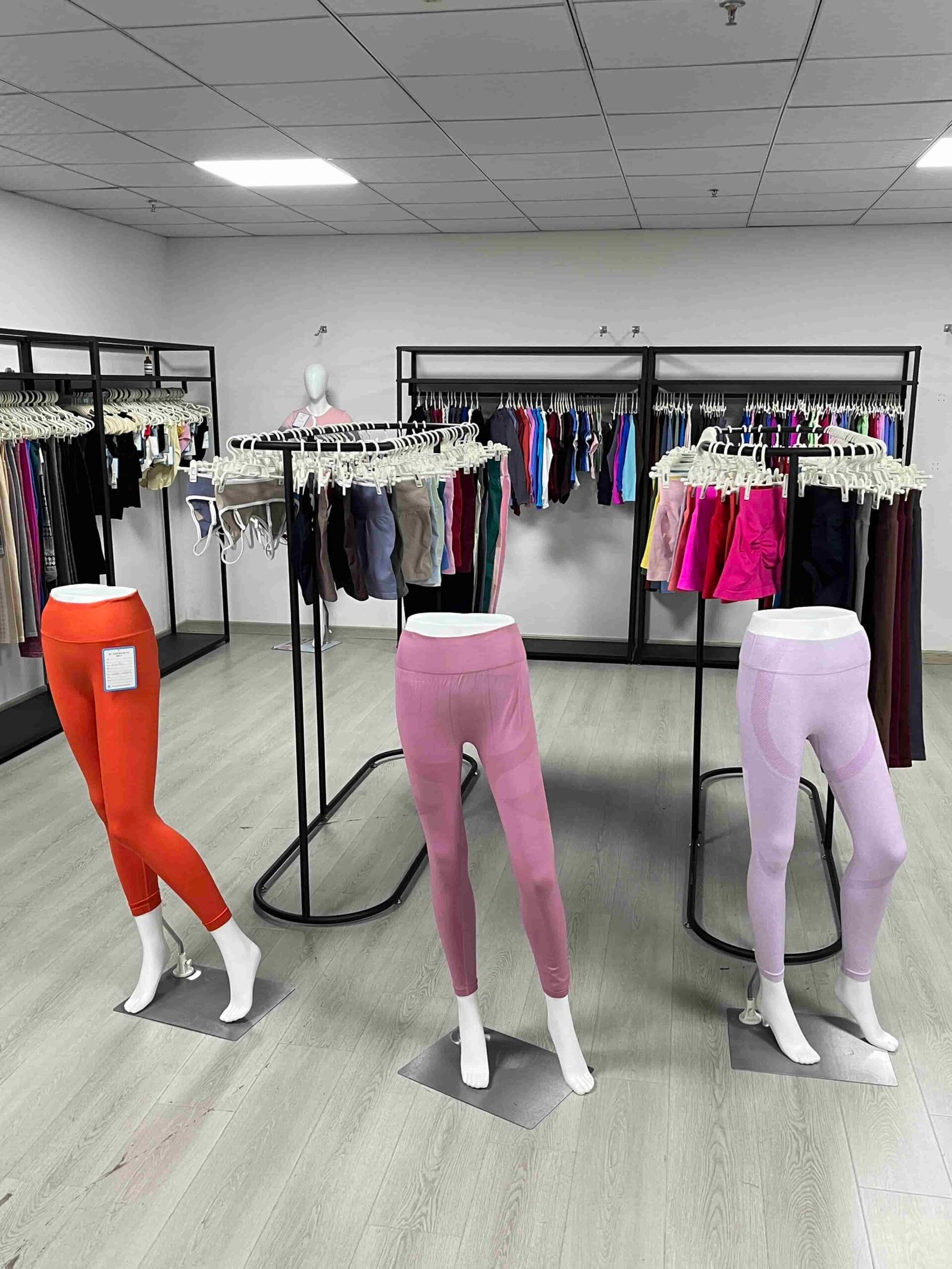
Actual MOVEVOX product development and sample-working area in Yiwu

Seamless Production Area

MOVEVOX's own seamless system includes 28 Italian Santoni machines. A technical visit should focus not only on machine count, but also on yarn, program version, knitted structure, inspection and how the approved sample is linked to production.
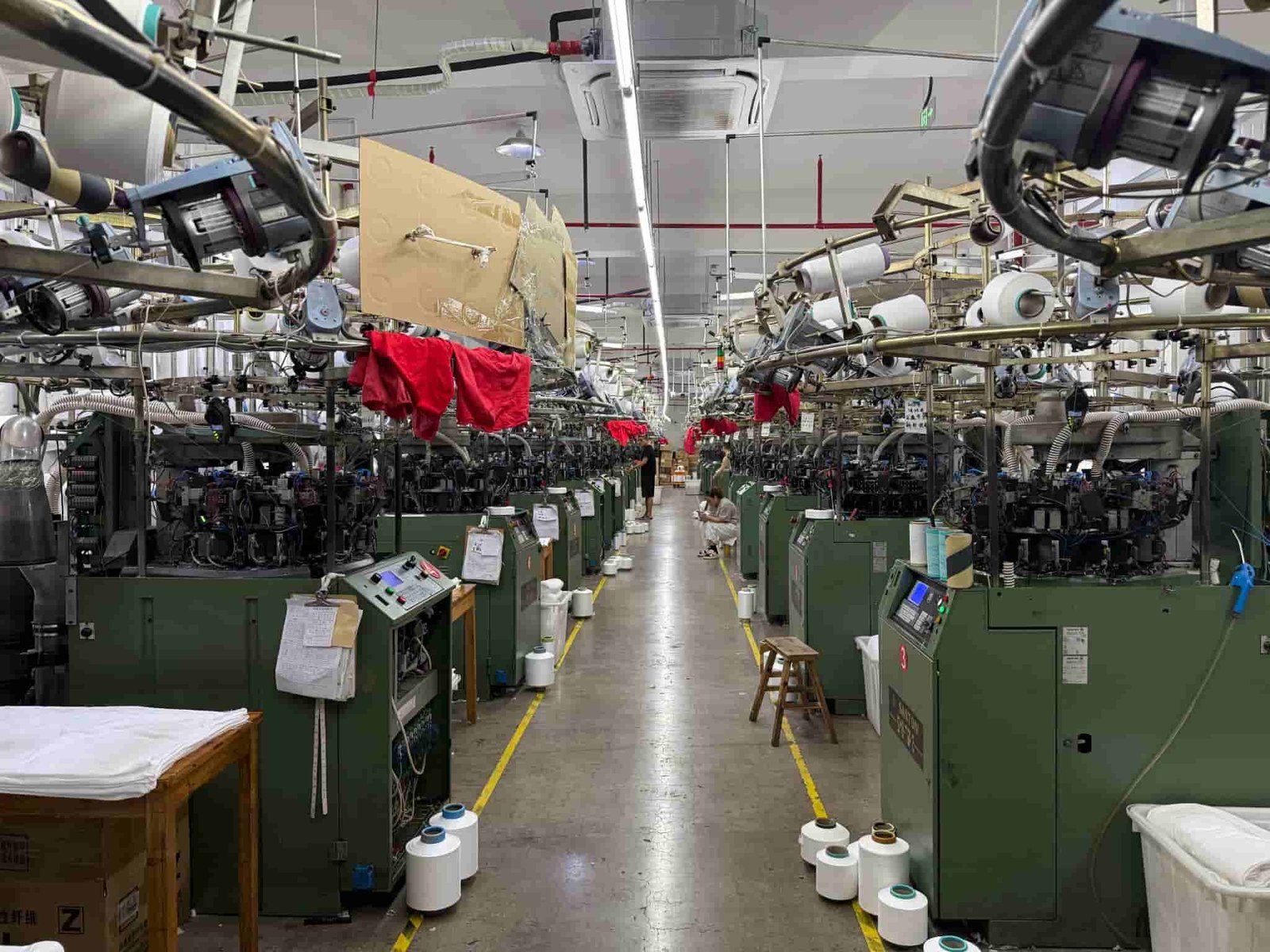
Italian Santoni seamless knitting equipment in the MOVEVOX Yiwu production base

Cut-and-Sew Area

The own-factory cut-and-sew system includes approximately 24 principal sewing and garment-making machines for products requiring pattern cutting, conventional seam construction, panels, pockets, gussets and other fabric-based structures.

Actual MOVEVOX cut-and-sew activewear production area in Yiwu

Quality Inspection Area

MOVEVOX currently has five QC personnel. Quality work includes material, first-article, inline, measurement, finished-garment, packing and final inspection activities according to project requirements.
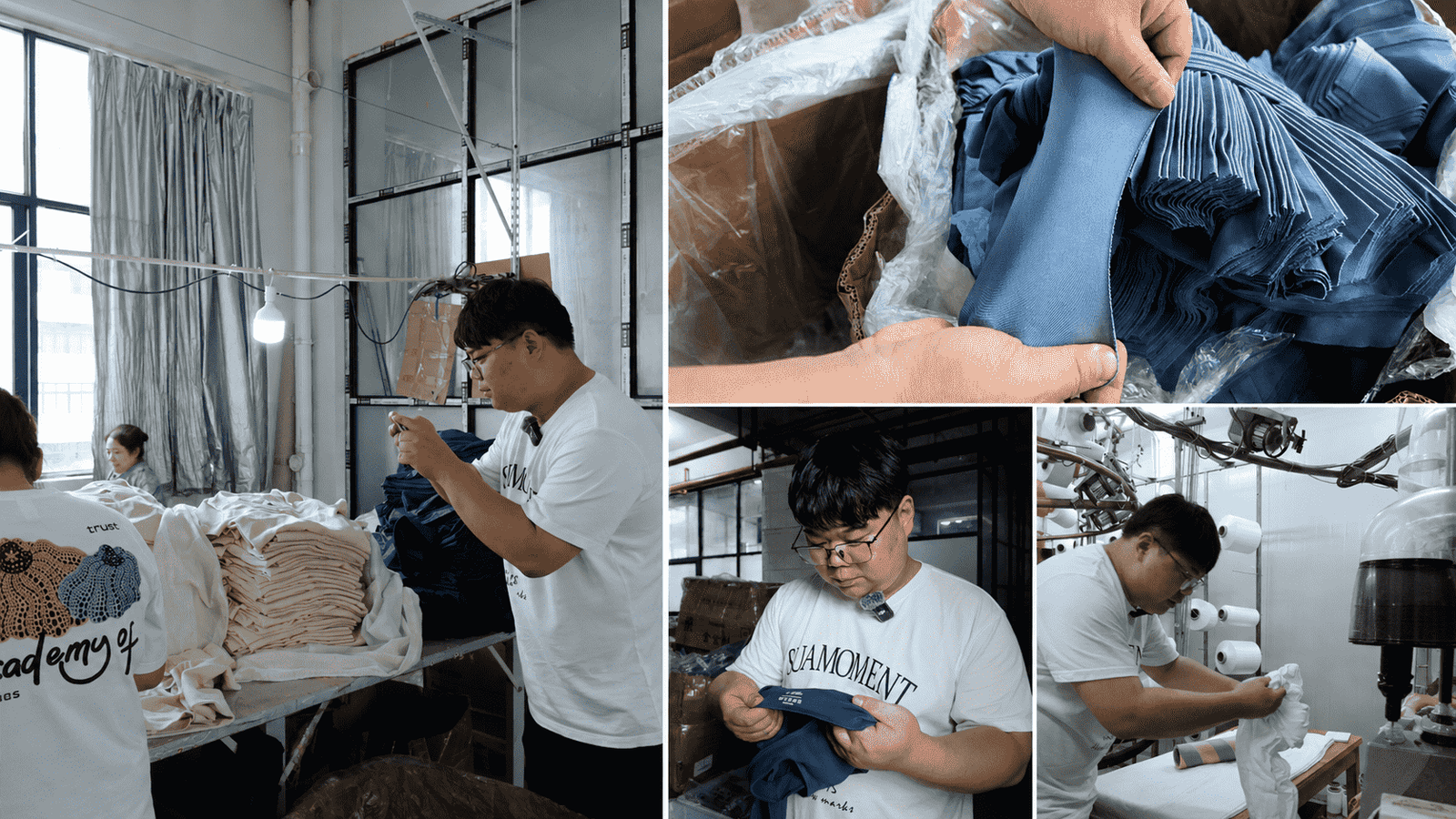
MOVEVOX QC staff measuring and inspecting activewear during production

Packing Area

Packing translates approved retail and shipment requirements into individual bags, labels, stickers, barcodes, carton information and other customer-specific details. Multi-size and multi-color programs require accurate SKU identification.
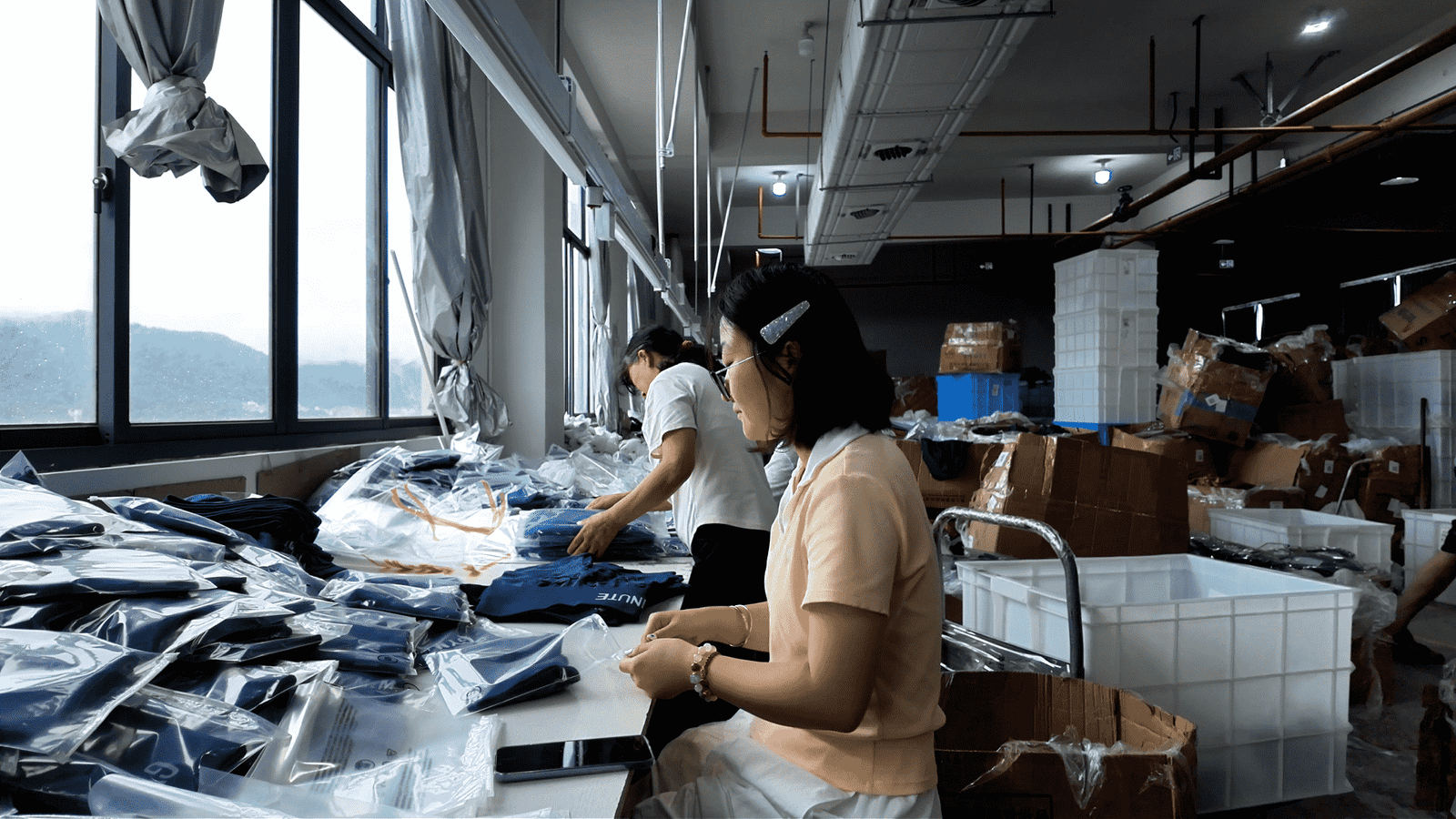
MOVEVOX activewear packing line with individual garment packaging and order identification

Warehouse and Staging

Material and finished-goods staging should make order identification and shipment preparation visible during an audit. Production, QC, packing and logistics information needs to remain connected before cargo release.
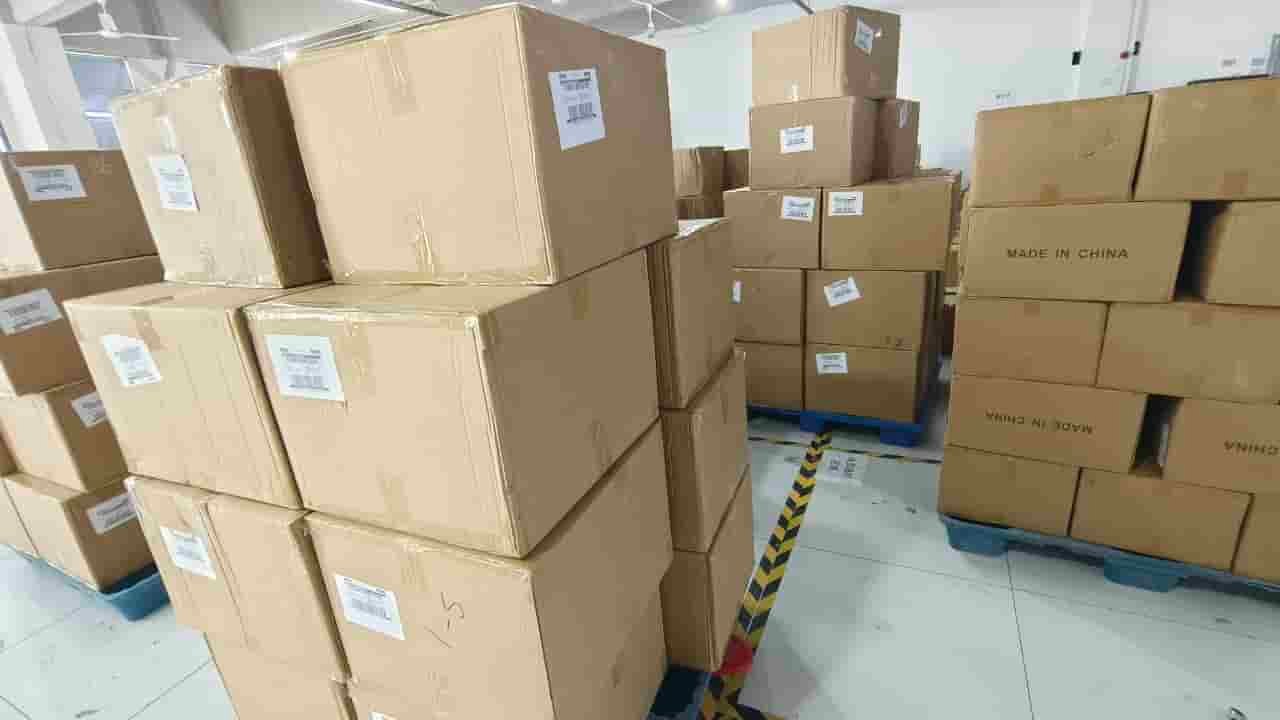
MOVEVOX export cartons and shipment staging area for finished activewear orders
TEST EVIDENCE SCOPE

How to Read MOVEVOX Test and Compliance Evidence Correctly

Compliance evidence should be read according to the tested sample, holder, test method, report date and stated scope. MOVEVOX does not treat one material or sample report as automatic certification of every garment, color or future production lot.
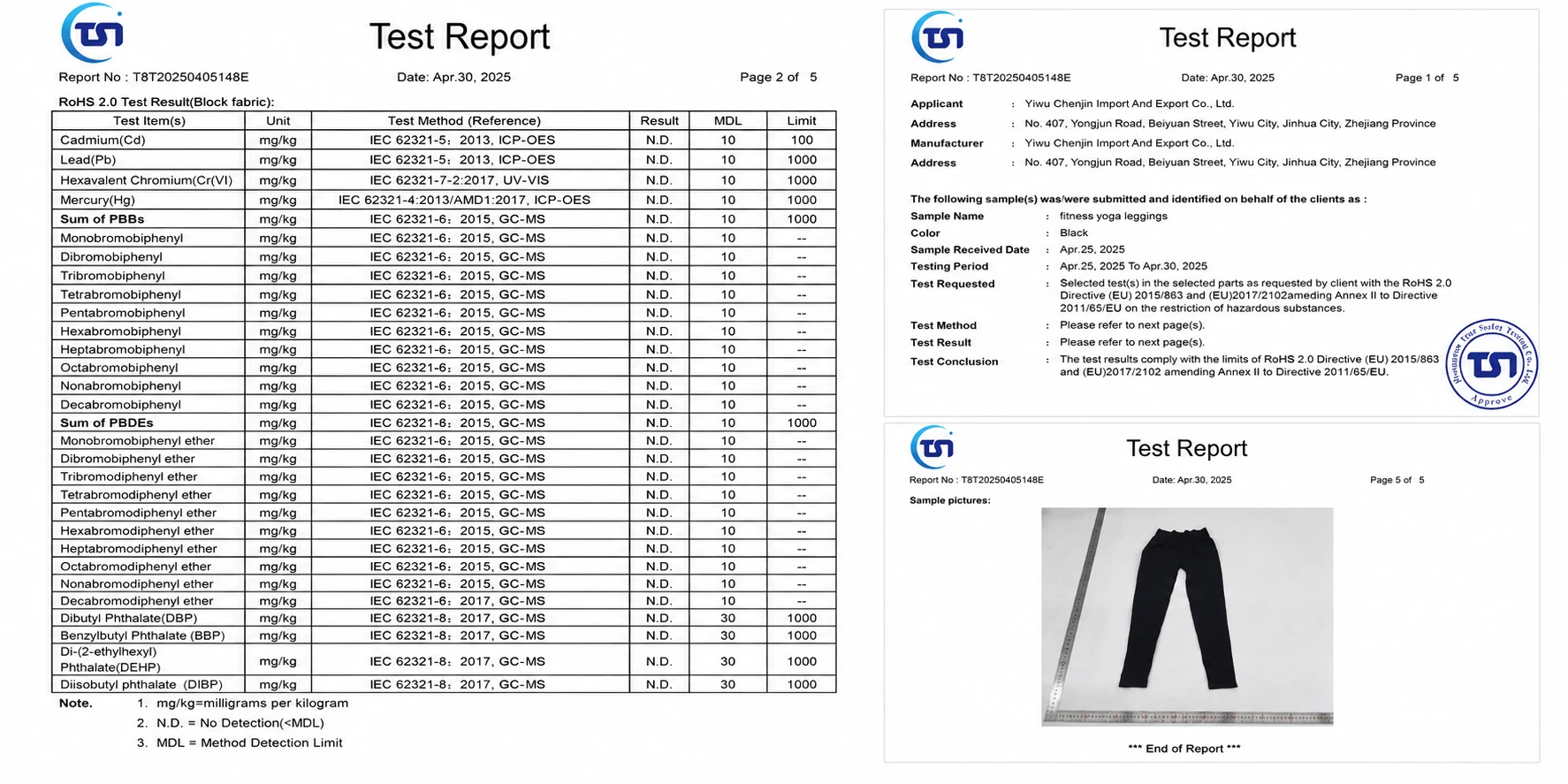
Third-party RoHS 2.0 test report for a black fitness yoga leggings sample submitted by Yiwu Chenjin Import And Export Co., Ltd.

RoHS Sample Test

A 2025 third-party test report identifies the applicant and manufacturer as Yiwu Chenjin Import And Export Co., Ltd. and the tested sample as black “fitness yoga leggings.” The report states that the tested sample results comply with the referenced RoHS 2.0 limits.

Applicable scope: The black fitness yoga leggings sample described in report TST20250405148E.
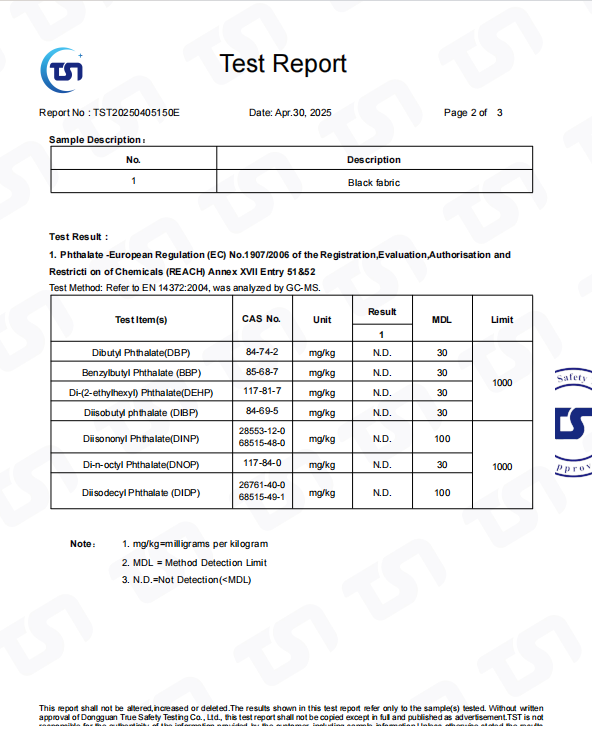
Third-party REACH Annex XVII phthalates test report for black fabric from the submitted fitness yoga leggings sample

Phthalates Test

A separate 2025 report tested black fabric from the submitted fitness yoga leggings against the referenced REACH Annex XVII Entry 51 & 52 phthalate requirements. The result summary states “Pass.”

Applicable scope: Black fabric sample described in report TST20250405150E.
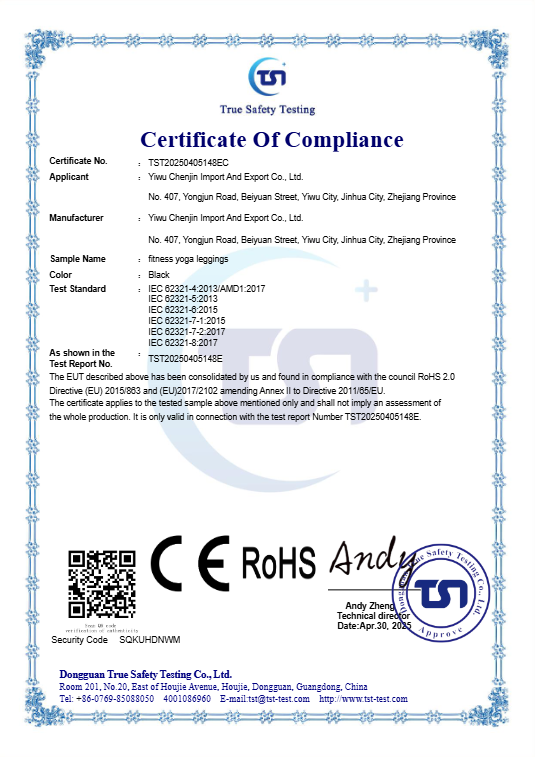
Certificate of Compliance linked to test report TST20250405148E for the tested fitness yoga leggings sample

Certificate Scope

Certificate TST20250405148EC is linked to test report TST20250405148E. The certificate itself states that it applies only to the tested sample and does not imply assessment of the whole production.

MOVEVOX response: Do not rewrite sample-level evidence as “MOVEVOX factory is RoHS certified.”

Buyer-Specific Testing

Global brands may have their own RSL, chemical, physical-performance or finished-garment testing requirements. MOVEVOX can coordinate required testing through customer-nominated or suitable laboratories according to the actual project.

Applicable scope: Individual buyer program and the actual submitted sample or material configuration.

REAL PROJECT CASE

U.S. Leggings Project: From Tech Pack to Repeat Production

A U.S.-based fitness customer developed a multi-product activewear program with MOVEVOX. The project shows how technical input, sample revisions, user testing, private-label packaging and detailed SKU controls can be carried from development into repeat bulk orders.

Customer Background

The customer is a U.S.-based fitness content creator operating an activewear business. Her product range includes fitness sets, leggings, shorts, sports bras, tank tops and one-piece garments. The program emphasizes stretch, support, opacity, soft hand feel and extended-size considerations, with regular new-style development and repeat purchasing.

Development Challenge

The customer worked from her own product Tech Pack and required the garment to perform for actual training use rather than only match a flat drawing. After reviewing the initial version, she identified design details that did not fully suit the intended use and requested another development round. The project also involved custom packaging, inserts, labels, logos, care labels and different QR-code information by product color and size.
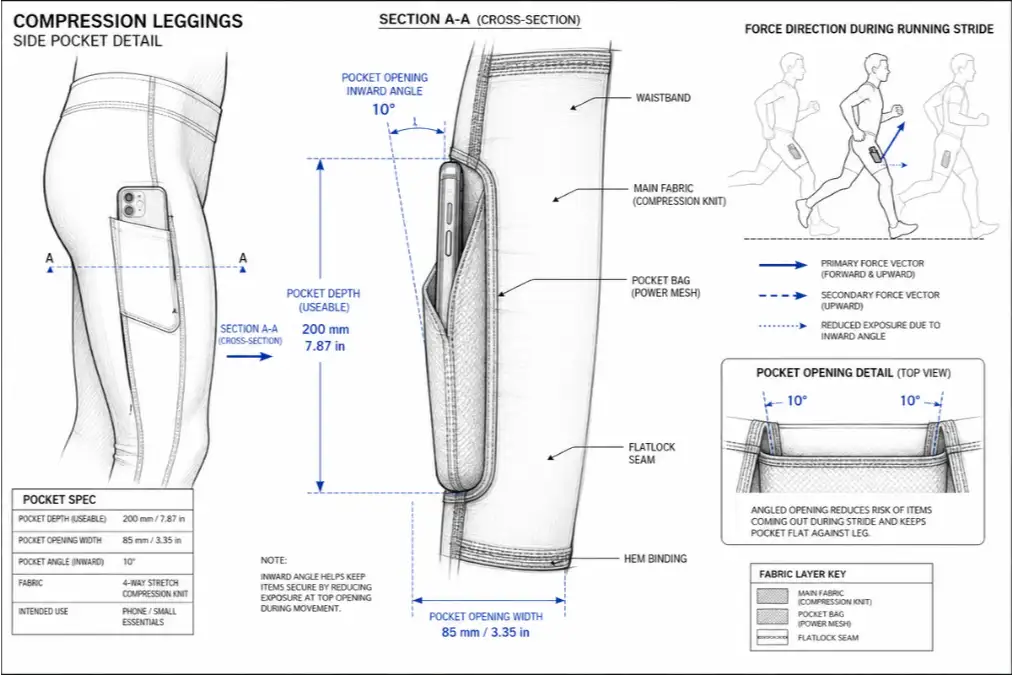
Anonymized U.S. activewear customer technical package and complex product-development evidence used in a MOVEVOX project

MOVEVOX Solution

MOVEVOX evaluated the Tech Pack and created the initial pattern and sample. After customer feedback, a second sample version was produced with the requested adjustments. Once the development direction was close to approval, approximately 5–10 additional samples were prepared for the customer's own user testing. After positive testing, the customer moved into bulk production.

For the commercial order, MOVEVOX coordinated branding and packaging requirements alongside the garment itself. QR-code labels created an additional packing-control risk because different colors and sizes required different identifiers. The team therefore checked product and QR information by style, color and size rather than treating packing as a generic final step.

Execution Path

  1. Tech Pack Review: customer technical package assessed and converted into the first physical sample.
  2. Sample Revision: customer feedback translated into a second version instead of moving directly into bulk.
  3. User Testing: approximately 5–10 samples prepared for real product testing.
  4. Bulk Standard: approved product direction combined with labels, logos, care labels, packaging and inserts.
  5. Packing Accuracy: color- and size-specific QR codes checked by individual style, color and size.
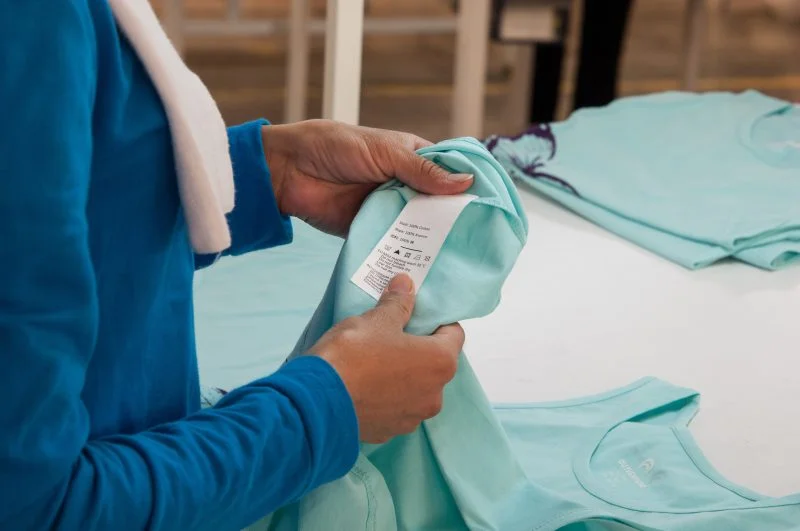
MOVEVOX verification of custom labels, QR codes and packaging information for a multi-size activewear order
2sample versions before the final test-sample stage
5–10test samples prepared for customer evaluation
≈2,000pieces in a typical order described in the case
3 yearscooperation reported in the available case record

The case record also describes approximately two purchases per month during the ongoing cooperation. No verified English customer quotation is available, so no direct quote is presented here.

REPEAT & SCALE CASE

Spain Case: From First Order to Recurring Production Support

This customer relationship illustrates how an initial product and branding program can develop into repeat orders, demand spikes and additional production planning without requiring the buyer to rebuild the supply relationship.

Initial Qualification

Sample Evaluation

The Spanish customer first purchased available samples and evaluated quality, fabric, workmanship, style and product details before moving forward with custom requirements. Sample delivery used DHL for the initial evaluation stage.

Development

Private Label Setup

After sample acceptance, the customer requested customized care labels, tags, packaging and logo application. MOVEVOX recommended a silicone-logo process and matte zipper-bag packaging for this program.

1,200 Pieces

First Bulk Order

The first bulk order was 1,200 pieces. According to the case record, production of the first batch was completed within 15 days. Part of the shipment moved by air and the balance by sea.

+1,200 Pieces

Early Reorder

Before receiving the first bulk shipment, the customer placed an additional order of 1,200 pieces during the second week, using the same processes and packaging as the initial production.

Repeat Orders

Recurring Cooperation

After the product entered the market, the customer reported strong sales and expanded online selling into another country. The cooperation developed into approximately two orders per month according to the case record.

≈3× Normal

Demand Spike

During one May order, the customer's required quantity increased to roughly three times its normal level. MOVEVOX added production-line resources and completed the order within the required production period stated in the case.

Replenishment Planning

Stock Support

Following the demand spike, MOVEVOX began maintaining inventory for styles selected by this customer, with the case record stating approximately 1,500 pieces per color for the relevant styles to support unusual replenishment needs.
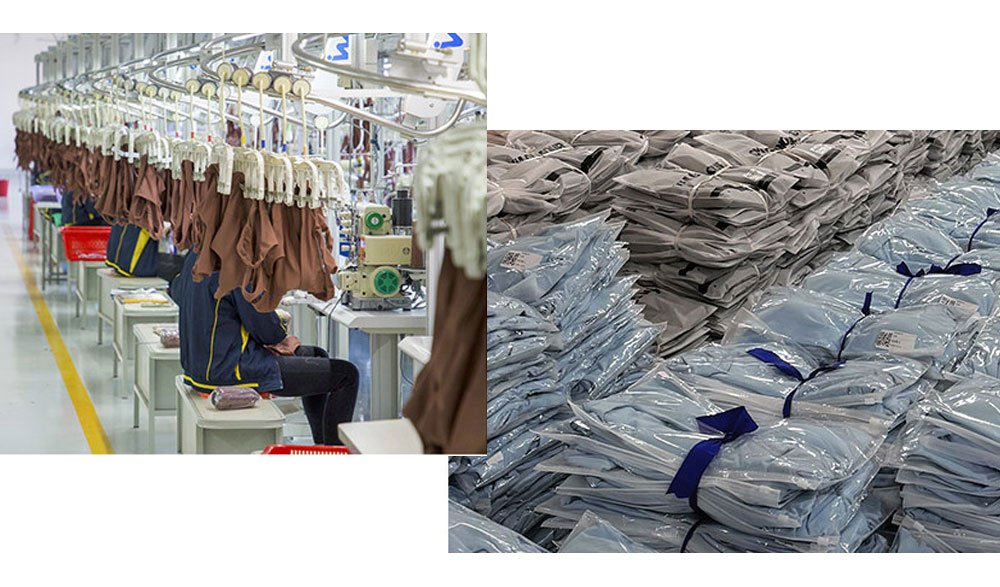
Custom private-label packaging evidence from the anonymized Spanish repeat-order customer case
MOVEVOX packed activewear order evidence used to support repeat-order execution
This case should not be interpreted as a universal promise of 15-day bulk production or fixed inventory for every customer. The value is the progression from sample validation to private-label execution, repeat orders, higher demand and customer-specific capacity planning.
SUPPLIER EVALUATION

Score Any Custom Leggings Manufacturer Before You Shortlist Them

Use the same questions whether you are evaluating MOVEVOX or another supplier. Strong supplier decisions come from verifiable development, manufacturing, quality and governance evidence—not from factory claims alone.

Product Development

Can the supplier develop from your actual Tech Pack or approved sample and control revisions through identifiable versions?

VerifiedNeeds EvidenceNot Applicable

Manufacturing Route

Can the supplier explain why seamless or cut-and-sew fits your design instead of forcing every style into one process?

VerifiedNeeds EvidenceNot Applicable

Fit & Measurement Control

Can the supplier work from your measurement chart, POM methods, grade rules and tolerances?

VerifiedNeeds EvidenceNot Applicable

Material Control

Are fabric or yarn references, color approval and material-lot checks tied to the actual product specification?

VerifiedNeeds EvidenceNot Applicable

MOQ Transparency

Are garment MOQ, custom-color MOQ, logo MOQ and packaging minimums distinguished rather than presented as one misleading number?

VerifiedNeeds EvidenceNot Applicable

Sample-to-Bulk Control

Is the approved sample translated into written production and inspection standards before bulk?

VerifiedNeeds EvidenceNot Applicable

Capacity & Site Transparency

Is stable delivery capacity separated from theoretical output, and are satellite or external production sites disclosed and controlled?

VerifiedNeeds EvidenceNot Applicable

Quality System

Are incoming, first-article, inline, measurement, finished-garment and final-release controls clearly defined?

VerifiedNeeds EvidenceNot Applicable

Auditability & Evidence Scope

Can buyers audit the manufacturing site, arrange inspection and verify that test reports are presented only within their actual sample scope?

VerifiedNeeds EvidenceNot Applicable

Repeat-Order Capability

Can the supplier return to approved standards and plan materials, capacity and quality for repeat or larger orders?

VerifiedNeeds EvidenceNot Applicable
A high score should mean the supplier can show how it develops, controls and documents your product—not simply answer “yes” to every question. Use MOVEVOX Sourcing Guides for additional supplier-evaluation context.
BUYER FAQ

Custom Leggings Manufacturer Frequently Asked Questions

These answers cover the development, MOQ, production and quality questions brands commonly need to resolve before starting a custom leggings project with MOVEVOX.

Can MOVEVOX develop leggings from our Tech Pack?

Yes. MOVEVOX can develop from a customer Tech Pack and use its drawings, measurement chart, material specification, construction, branding and packaging requirements as the starting point. The team first reviews the information for missing details, conflicts or manufacturability questions. Where clarification is required, open points should be resolved before the relevant specification is locked. MOVEVOX can also develop from authorized physical samples, sketches, images or clearly defined product requirements when a full Tech Pack is not available.

Can you work from an existing physical sample?

Yes, provided the customer owns or is authorized to use the reference. MOVEVOX can measure and analyze the garment structure, key POM, seam or knitted construction, material behavior and branding details, then develop an equivalent project standard. A reference sample does not guarantee that the identical original material remains commercially available, so material matching or substitution may still require sample and fit validation. MOVEVOX does not position unauthorized copying of third-party branded products as a normal development service.

Do you manufacture both seamless and cut-and-sew leggings?

Yes. MOVEVOX's own manufacturing system includes 28 Italian Santoni seamless machines and approximately 24 principal sewing and garment-making machines. Seamless and cut-and-sew are treated as different engineering routes rather than interchangeable labels. Seamless can support knitted rib, mesh, jacquard, texture and zoned structures, while cut-and-sew can offer greater flexibility for panels, gussets, pockets and fabric-based construction. The recommended route depends on the actual design.

How long does standard sample development take?

Standard sample development typically takes about 5–10 working days after the necessary development details have been sufficiently confirmed. That period should not be interpreted as a guaranteed total calendar time for every project. Custom dyeing, special materials, custom seamless yarn, unusual branding processes, customer revision rounds and international courier transit can extend the overall timeline. MOVEVOX therefore confirms actual sample timing after reviewing the specific style and its open development requirements.

What is MOVEVOX's MOQ for custom leggings?

The current regular starting point is approximately 100 pieces per style for seamless customization and approximately 150 pieces per style for cut-and-sew customization. These figures represent base garment MOQ under suitable material and process conditions, not a universal quantity for every possible specification. Custom colors, special fabrics, molded branding, jacquard, specialized trims or custom packaging can each have independent supplier minimums. The effective project MOQ is confirmed after the style, material, color and customization plan are reviewed.

Why can custom colors require a higher MOQ?

Custom dyeing is typically managed by the fabric or yarn supplier according to a minimum dye lot. MOVEVOX's current reference is that custom color often needs evaluation around approximately 400–600 finished pieces per color depending on material, product structure and dye-lot conditions. This is separate from the base garment MOQ. When lower quantities are required, available stock colors or existing material resources may offer a more practical development route, subject to actual availability.

Can we split the MOQ across several colors?

Color and size allocation depends on the manufacturing route, material availability and order structure. The headline garment MOQ should not be interpreted as permission to divide a style into unlimited colors and very small size quantities. Some materials have stock colors, while custom dyeing can create a substantially higher color-specific minimum. MOVEVOX reviews the proposed SKU structure during quotation so the buyer can understand whether the requested split is operationally workable before sampling or production begins.

Is a lower MOQ always better for a new brand?

Not necessarily. A lower starting quantity can reduce inventory exposure, but it should still allow a manufacturer to execute the intended material, color, branding and size structure correctly. MOVEVOX's approach is to support a reasonably flexible product-validation stage without positioning itself as an unlimited ultra-low-MOQ supplier. Buyers should compare entry quantity together with sample discipline, material availability, quality controls and the supplier's ability to support repeat orders if the product succeeds.

What is the normal bulk-production lead time?

Regular bulk production is generally around 20–35 days, but actual timing depends on material readiness, construction complexity, quantity, colors, branding, packaging, buyer approval, inspection requirements and capacity. The production clock should not be separated from material procurement: custom dyeing, special materials or custom seamless yarn can require additional lead time before bulk manufacturing begins. MOVEVOX therefore confirms delivery through a project-specific T&A rather than promising the same number of days for every leggings order.

Does MOVEVOX use satellite factories?

Yes. MOVEVOX currently works with eight long-term satellite factories—six in Yiwu and two in Guangzhou—alongside its own core factory. The core factory remains the center for development, technical standards, key production and quality control, while suitable repeatable bulk work can be allocated to controlled satellite capacity. MOVEVOX issues the applicable technical information, material requirements and quality standards. Satellite factories do not independently redefine customer specifications or automatically become separate suppliers to the buyer.

Can our order be moved to another factory without approval?

Where a buyer requires Approved Factory Only, specifies a production site, requires factory audit approval or contractually restricts subcontracting, MOVEVOX does not change that production location without the required written approval. For authorized production transfers, the new assignment should still go through capability review, controlled technical-document transfer, first-article verification and relevant quality checks. MOVEVOX's intended model is controlled and transparent capacity management rather than hidden subcontracting.

What capacity can MOVEVOX support?

MOVEVOX currently states normal managed combined stable delivery capacity of approximately 150,000–200,000 pieces per month across its own production and controlled network. This figure is deliberately described as managed stable capacity rather than maximum theoretical output. Formal capacity for a leggings program still depends on style complexity, seamless or cut-and-sew route, number of SKUs, material availability, packing workload, quality requirements and production-site allocation. Larger programs should therefore complete a capacity review before delivery commitments are confirmed.

How do you control sample-to-bulk consistency?

MOVEVOX converts the approved project into production references that can include the final Tech Pack, measurement specification, approved or PP sample, material and color references, logo and label requirements and packing instructions. Before and during production, the team uses production-readiness review, first-article inspection, in-line checks, finished-garment inspection and final release controls. The objective is to keep bulk output within approved standards and tolerances rather than claim that industrial production can be “100% identical” without any measurable tolerance.

How do you inspect leggings measurements?

Leggings are measured against the final approved Measurement Spec/POM using an aligned measurement method. MOVEVOX does not treat a size name such as M or XL as the production specification itself. Customer tolerances take priority. Internal reference tolerances are used only when the buyer has not supplied its own standard. During production, measurement sampling can be increased when a risk or out-of-tolerance trend appears, allowing the team to screen critical POM more extensively before final release.

Can we arrange a factory audit or third-party inspection?

Yes. MOVEVOX supports customer factory audits, technical audits, pre-production visits, inline inspections and pre-shipment inspections, subject to production scheduling and confidentiality requirements around other customers' projects. Live video factory tours can also be arranged. Third-party inspection can be supported according to the buyer's requirements. Buyers should specify the intended audit or inspection scope early so documents, production areas, product status and relevant personnel can be prepared appropriately.

Are all MOVEVOX leggings certified to RoHS or REACH?

No blanket claim should be made. MOVEVOX currently has third-party test documents for a specific black fitness yoga leggings sample and black fabric. The relevant 2025 reports record a RoHS 2.0 compliance conclusion for the tested sample and a Pass result for the referenced REACH Annex XVII phthalate test. The associated certificate explicitly states that it applies only to the tested sample and does not imply assessment of the whole production. Project claims must therefore follow actual report scope.

STRUCTURED RFQ

Start Your Custom Leggings Project

Share the essentials of your project so MOVEVOX can identify the right manufacturing route, development starting point, MOQ considerations and next commercial or sampling step.

Step 1 — Contact

Prepare the basic buyer and company information needed for project ownership and follow-up.

NameWork EmailCompanyMarketWhatsAppRole

Step 2 — Product

Identify what you are developing and whether the manufacturing route is already defined.

Product TypeSeamlessCut-and-SewNeed RecommendationDevelopment StageSize Range

Step 3 — Customization

Outline the material, branding and construction areas that affect development and quotation.

Fabric RequirementColor RequirementLogo MethodLabelsPackagingSpecial Construction

Step 4 — Order Plan

Commercial structure helps MOVEVOX review MOQ, material sourcing, capacity and timing.

Estimated QuantityColor CountSize BreakdownTarget LaunchDestinationRepeat Potential

Step 5 — Files

Tech Packs, reference files, measurement charts and artwork help the manufacturing review move faster.

Tech PackReference FileMeasurement ChartArtworkProject Message
Project summary prompt: Please confirm your product, estimated quantity, development input and target timing before submitting.

Your project files are used for requirement review and manufacturing communication before the next quotation, sampling or qualification step.

Send Us an Inquiry

Tell us your needs, and our team will get back to you within 24 hours.

START YOUR PROJECT

Ready to Develop Your Private Label Activewear Line?

Tell us what you want to develop, your estimated quantity and customization needs. We will review the details and suggest the next practical step for sampling, quotation or production.

Helpful details to include:

Request MOQ & Sample Details