
Seamless Activewear Sets Manufacturer for Coordinated Brand Collections
MOVEVOX supports activewear brands developing coordinated seamless sports bras, leggings, shorts and tops through Santoni knitting, product development and quality-managed manufacturing. Different garments can share a recognizable collection identity while requiring distinct knit structures, fit and performance specifications. We help buyers discuss these technical relationships before confirming samples, production quantities and commercial requirements.
Develop a Seamless Collection
Build coordinated garments from a defined product concept, knit structure direction, color reference and individual fit requirements. Technical development should establish which specifications can be shared across the collection and which need separate approval before production planning.
- Define shared colors and visual knit language.
- Review independent bra and bottom fit requirements.
- Establish sample priorities and collection approval criteria.
Qualify Existing Set Specifications
For brands with approved samples or Tech Packs, supplier evaluation begins with identifying critical construction, yarn, color and dimensional requirements. Each garment needs its own production reference, while the complete set needs agreed standards for visual coordination.
- Compare existing specifications with manufacturing capabilities.
- Identify yarn, knitting and measurement constraints.
- Review production assumptions and required qualification evidence.
What Makes Different Seamless Garments Work Together?
A coordinated seamless collection does not require identical yarns, knit structures or stretch values across every garment. It requires each product to satisfy its own functional specifications while meeting shared color, appearance, branding and commercial requirements. Compatibility should therefore be evaluated at both individual-garment and complete-set levels.
Independent Garment Specifications
A sports bra and leggings have different fit and construction priorities. Their measurements, relevant stretch properties and critical knit zones should be defined separately.
Shared Collection Requirements
A collection may share color references, brand artwork, visual knit language and packaging rules without requiring identical material construction or mechanical performance.
Cross-Garment Compatibility
Different knit densities, yarns and surface structures can change perceived color and texture. Buyers should assess the garments together under agreed observation conditions.
Set-Level Acceptance
Two individually acceptable garments may still create an unacceptable set because of visible mismatch, incorrect size pairing, incomplete quantities or packaging errors.
Why It Matters
MOVEVOX has actual seamless knitting and product development resources. A proposed collection review can distinguish garment-specific approvals from shared set requirements before commercial production decisions.
Six Compatibility Risks Within Coordinated Seamless Activewear Sets
Separate garments can meet their own specifications yet create difficulties when sold together. The following matrix identifies cross-garment risks and suitable review actions. These are procurement considerations, not reported MOVEVOX customer failures or verified historical incidents.
Cross-Garment Risk Matrix
| Technical Problem | Procurement Impact | Proposed MOVEVOX Review Approach |
|---|---|---|
| Different Shade Appearance. Rib, mesh and dense knit constructions may reflect light differently, even when garments share a nominal color reference. Relaxed and stretched conditions can also change visual appearance. | A bra and leggings may individually match approved material references but look inconsistent when displayed together. This can delay collection approval, create disagreements over acceptance or require additional sampling. | Compare actual garments and representative knit structures under agreed observation conditions. Separate material shade assessment from complete-set visual acceptance, and obtain buyer approval for any intentional difference between components. |
| Unequal Elastic Response. Different garments may use separate stitch structures and elastic-yarn arrangements. Equal nominal fiber composition does not guarantee comparable elongation, recovery or perceived resistance during wear. | Imposing one mechanical target across the set may compromise an underbust band, waistband or leg opening. The resulting samples may require unnecessary revisions or fail garment-specific fit expectations. | Define performance requirements independently for each SKU and critical zone. Discuss suitable testing where required, while keeping shared collection standards focused on appearance and commercial compatibility rather than identical elasticity. |
| Conflicting Size Relationships. Bra and legging sizes can reflect different body measurements and fit priorities. A predetermined top-and-bottom pairing may not suit the intended retail or customer sizing model. | Even when production quantities appear sufficient, certain pairings may be unavailable. Incorrect size assumptions can create unbalanced inventory, retail bundle errors and delayed packing or shipment decisions. | Review separate size charts and intended pairing rules before approving the order breakdown. Distinguish fixed-size bundles from independently selectable tops and bottoms, then confirm SKU and packing requirements accordingly. |
| Unapproved Material Substitution. Yarn alternatives with similar composition may differ in structure, appearance or elastic behavior. A change affecting only one component may disrupt previously approved collection relationships. | Replacing a material to address availability or cost may require more than single-product inspection. An altered garment could remain usable individually while no longer matching the approved set. | Review substitutions against each garment's specifications and the shared set reference. Identify when additional knit trials, visual comparisons or mechanical evaluation should precede buyer authorization and production use. |
| Incomplete Collection Approval. Separate sample approvals may overlook the final comparison of color, surface texture, size combination, branding and commercial presentation across the coordinated products. | Bulk production may begin before the buyer has agreed on what constitutes an acceptable complete set. Later disagreements could affect inventory, packing plans and the intended launch schedule. | Recommend two distinct approval records: one for each garment's technical requirements and another for the complete collection's shared characteristics. Do not treat the proposed matrix as an already implemented customer procedure. |
| Partial Replenishment Mismatch. One garment may require reorder earlier than another, introducing a new yarn lot, processing condition or approved program revision while matching stock remains available. | A newly produced legging might satisfy its own specifications but appear different beside a previously manufactured bra. Replacement quantities and matching-set availability may then require further evaluation. | Compare the proposed reorder against current approved references and any relevant existing-stock samples. Confirm material, shade and program changes before deciding which new approval or buyer notification is necessary. |
Which Knit Specifications Should Seamless Set Components Share?
A collection can use coordinated materials and design language without enforcing identical construction. The table compares four common seamless garment types and identifies where shared references are useful, where independent technical specifications remain necessary and what buyers should verify.
Cross-Garment Technical Specification Matrix
| Parameter | Sports Bra | Leggings | Shorts | Tank Top |
|---|---|---|---|---|
| Color reference | Shared collection target | Shared collection target | Shared collection target | Shared collection target |
| Yarn composition | Product-specific approval | Product-specific approval | Product-specific approval | Product-specific approval |
| Yarn construction | Review band and body needs | Review coverage and extension | Review waist and leg needs | Review body and armhole needs |
| Knit structure | Underbust / body / mesh | Waist / hip / thigh | Waist / seat / leg opening | Body / side / back |
| Elastic response | Bra-specific acceptance | Legging-specific acceptance | Short-specific acceptance | Top-specific acceptance |
| Recovery priority | Underbust and fit stability | Waistband and shape retention | Waist and leg opening | Hem and neckline where relevant |
| Opacity assessment | Relevant coverage zones | Critical under extension | Critical where applicable | Product-specific coverage |
| Size grading | Bust / underbust | Waist / hip / inseam | Waist / hip / length | Bust / body length |
| Knit-zone placement | Chest / underbust / back | Waist / hip / leg | Waist / glute / leg | Front / side / back |
| Texture appearance | Match visual language | Match visual language | Match visual language | Match visual language |
| Sample approval | Independent SKU | Independent SKU | Independent SKU | Independent SKU |
| Set approval | Combined visual check | Combined visual check | Combined visual check | Combined visual check |
Recommended Specification Strategy
A shared collection platform should identify which characteristics are genuinely common and which require separate engineering approval. Color references and visual knit language may be shared, while stretch force, garment measurements and critical structural zones should follow each product's functional needs. When using a related yarn family, buyers should still review construction compatibility, material availability and the resulting fabric appearance. A shared specification is useful only when its scope is explicit. MOVEVOX can discuss these requirements through its seamless development capabilities; confirmed technical performance depends on the actual samples and approved project conditions.
Approving Seamless Set Colors Across Different Knit Structures
A common color reference does not guarantee identical appearance across garments with different yarns, densities and surface structures. Collection approval should consider the actual materials, finished knit constructions, observation conditions and intended appearance of the products together.
01 — Color Reference
Start with the buyer's approved physical color reference or applicable color specification. Identify which garments belong to the same intended colorway and whether any texture-related appearance differences are acceptable as part of the design.
02 — Material Review
Review the proposed yarns and material specifications for each garment. Similar fiber percentages do not guarantee identical dye uptake or surface appearance, particularly when construction, suppliers or processing routes differ between the upper and lower garment.
03 — Knit Samples
Examine representative samples of the actual rib, mesh, jacquard or dense knit constructions. Small color swatches may be useful, but they should not replace finished garment comparisons when structure or extension materially affects the visual result.
04 — Relaxed Appearance
Compare the garments in their specified relaxed state under agreed lighting and viewing conditions. Observe shade, surface reflection, apparent depth and overall coordination. Record any intentional differences rather than treating every visible variation as an automatic defect.
05 — Stretched Appearance
Where product use makes it relevant, review the fabrics at a defined extension or on an appropriate fitting form. Stretch can change loop spacing, coverage and perceived shade, especially between open and compact knit constructions.
06 — Set Approval
Assess the complete intended set using the buyer's agreed visual standards. Individual yarn or fabric acceptance should not automatically replace collection-level approval. Identify accepted garments, unresolved differences and the authority required to release the design.
07 — Reorder Reference
Retain the relevant approved material and garment references needed for future comparison. When yarn lots, processing conditions or constructions change, determine whether fresh samples should be reviewed against existing coordinated products before accepting a reorder.
Color Measurement Boundary
Instrumental color-difference calculations and visual matching are related but distinct. ISO 105-J03 addresses calculated differences between specimens of the same material measured under the same conditions; it does not automatically validate one universal tolerance across different knit constructions. Buyers should approve suitable methods and limits for the actual materials and set.
Why Coordinated Seamless Garments Need Different Elastic Standards
Visual coordination does not require identical mechanical performance. A sports bra, leggings, shorts and tank top may use related yarns or knit patterns while requiring different extension, recovery, coverage and fit criteria according to the role of each garment.
Bra Underbust
Performance Requirement: Define band fit and elastic resistance independently.
A seamless underbust band should be evaluated for the intended body fit, extension and ability to maintain its approved form. More resistance is not automatically better: excessive tightness may conflict with comfort, while insufficient resistance may affect the intended fit. Review the construction and sample performance rather than inferring support from visible rib density alone.
Bra Body
Performance Requirement: Balance coverage, extension and intended garment support.
The body of a seamless sports bra may include different zones for coverage, movement and appearance. Stretch behavior should be considered with the complete garment construction, including any permitted padding or assembly details. A general claim of support should not become a quantified performance statement without appropriate product-specific verification.
Leggings Waistband
Performance Requirement: Define waistband extension, recovery and fit acceptance.
The waistband of leggings may use a different knit structure from the sports bra's underbust area, even when the set shares a matching rib texture. Measurements, elastic recovery and rolling tendency should be reviewed against the intended fit. Visual similarity alone does not demonstrate equivalent or appropriate mechanical behavior.
Leggings Hip and Thigh
Performance Requirement: Evaluate coverage and extension during intended movement.
Leggings must accommodate the relevant hip and thigh extension without losing the buyer's required fit or appearance. Different knit structures may alter opacity and perceived shade under load. Acceptance should consider the specified garment, size, fabric state and end use rather than generic four-way-stretch descriptions.
Shorts Leg Opening
Performance Requirement: Review local fit and dimensional recovery separately.
A shorts leg opening may need different mechanical behavior from either a sports bra band or a leggings waistband. Depending on design, buyers may examine curling, localized tightness and retention of the approved opening shape. Each feature should be evaluated within its own garment construction and fitting conditions.
Tank Body
Performance Requirement: Match collection appearance without forcing compression.
A seamless tank can share color and knitted texture with leggings while providing a different fit profile. The intended drape, stretch and recovery may differ substantially from fitted bottoms. Structural alignment and garment comfort should therefore be evaluated separately from the collection's shared visual identity.
How to Approve Garments and Sets Separately
A coordinated set should pass two different decisions: each garment must satisfy its approved technical requirements, and the complete collection must meet shared appearance and commercial specifications. The checklist below is a proposed buyer assessment tool, not an existing external audit certification.
A — Individual Garment Identity
- Verify the style, color, size and current sample version for each garment.
- Confirm that material and yarn references match the intended construction requirements.
- Review relevant knit-zone placement against the approved product reference.
- Identify any unresolved structure, assembly or workmanship changes before sample approval.
B — Individual Performance
- Approve garment-specific POMs, measurement states and applicable dimensional tolerances.
- Determine which stretch and recovery requirements need suitable testing evidence.
- Confirm fit independently for the bra, top, leggings or shorts.
- Check relevant opacity, coverage and wear-related appearance requirements where applicable.
C — Collection Compatibility
- Review the complete set under agreed physical color comparison conditions.
- Compare rib, mesh, jacquard and texture appearance across related garments.
- Approve intended top-and-bottom pairing and independent size selection rules.
- Identify which shared standards apply to future colorways and repeat orders.
D — Commercial Release
- Confirm style-level and set-level quantities using clearly defined units.
- Check SKU labels, barcodes and intended packing or sales configurations.
- Record which technical deviations still require explicit buyer authorization.
- Confirm that all required set approvals exist before commercial release.
Assessment Options: Yes / No / Further Review Required
Interpreting the Assessment
A positive result for an individual garment does not automatically establish complete-set compatibility. Buyers should examine unresolved questions according to their importance rather than calculating a superficial total score. A critical color, fit, material or product-identity issue may require additional review even when most checklist items are complete. Each decision should identify the applicable specification and approval responsibility. MOVEVOX can use this framework for project discussion, subject to confirming an appropriate record format.
Pairing Seamless Top and Bottom Sizes Correctly
A seamless bra and leggings follow different body dimensions, garment structures and fit requirements. Brands should distinguish independently approved size charts from retail pairing rules, especially when customers may choose different sizes for the upper and lower garments.
Proposed Size-Pairing Review Matrix
| Size Reference | Top Measurement Basis | Bottom Measurement Basis | Fixed Bundle | Independent Pairing |
|---|---|---|---|---|
| XS | Approved bust / underbust POMs | Approved waist / hip POMs | Buyer-defined | Available if specified |
| S | Approved bust / underbust POMs | Approved waist / hip POMs | Buyer-defined | Available if specified |
| M | Approved bust / underbust POMs | Approved waist / hip POMs | Buyer-defined | Available if specified |
| L | Approved bust / underbust POMs | Approved waist / hip POMs | Buyer-defined | Available if specified |
| XL | Approved bust / underbust POMs | Approved waist / hip POMs | Buyer-defined | Available if specified |
| XXL | Approved bust / underbust POMs | Approved waist / hip POMs | Buyer-defined | Available if specified |
Fit and Grading Considerations
The size label used for a commercial bundle does not automatically establish technical fit compatibility. A sports bra and leggings need independent measurements and sample evaluations, while the brand determines whether customers purchase fixed combinations or select each size separately. The collection's SKU structure should reflect that decision. If a size range is expanded, knitted zone placement and garment dimensions may require further validation. This matrix contains no invented MOVEVOX product measurements.
Three Considerations
- Keep upper and lower garment size charts technically independent.
- Confirm commercial pairing rules before calculating complete-set availability.
- Review new sizes against appropriate physical fit and measurement references.
Choose Seamless Set Combinations by Their Engineering Needs
MOVEVOX's seamless manufacturing capabilities support discussions around coordinated sports bras, leggings, shorts and tops. The right combination depends on each garment's construction and fit requirements as well as the shared color, texture, branding and commercial expectations of the collection.
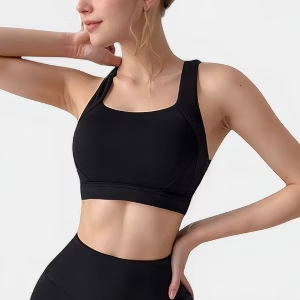
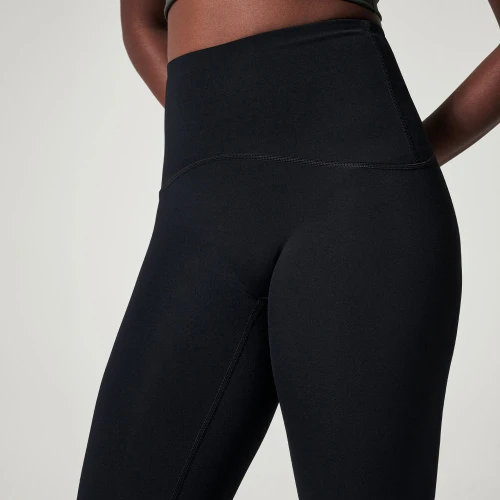
Bra and Leggings
A coordinated sports bra and leggings set combines two technically different garments. Underbust fit and chest coverage need independent review from the waistband, hip and leg requirements of the bottoms. Shared color and texture may create the visual identity, while mechanical performance and garment measurements should remain product-specific. A complete-set review should follow the relevant individual sample approvals.
Components: Seamless Sports Bra · Seamless Leggings · Shared Color Reference · Independent Size Specifications
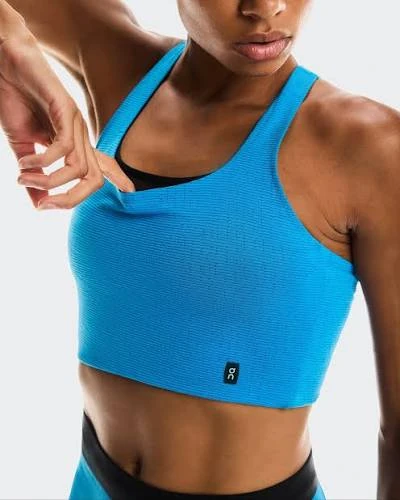
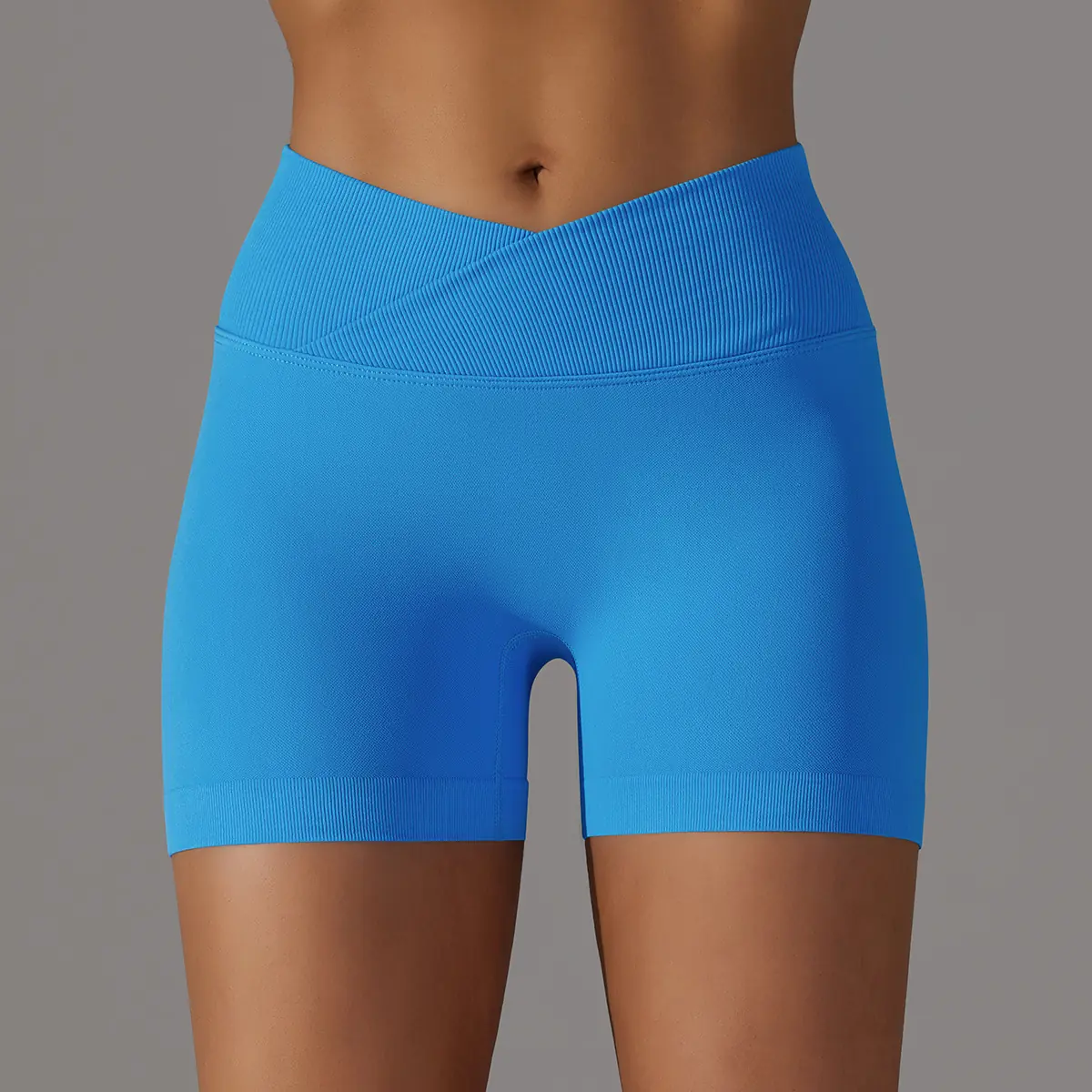
Bra and Shorts
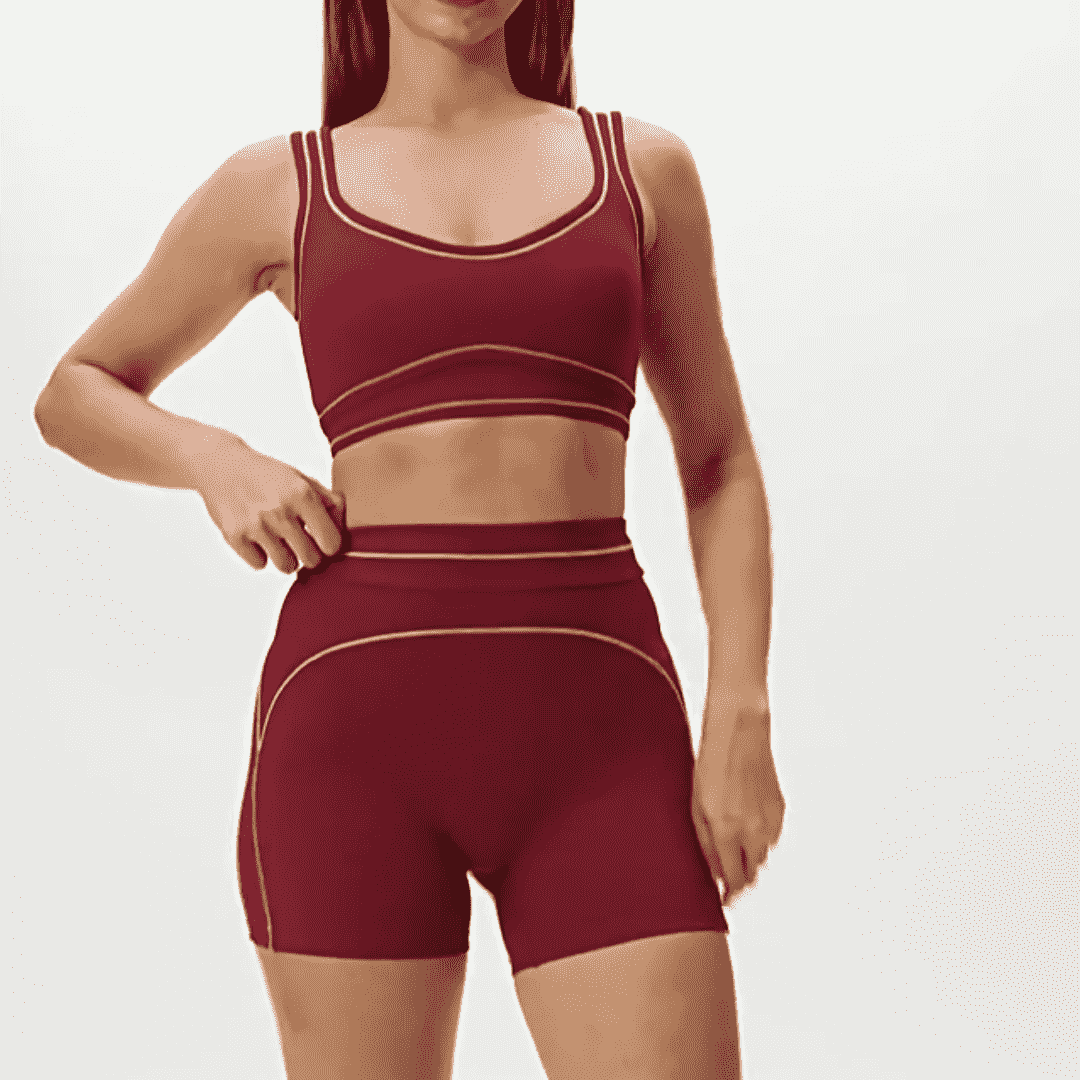
This combination may suit brands developing training, gym or studio-related collections. A bra's underbust structure and the shorts' waistband and leg openings present different fit and recovery considerations. Surface texture, color reference and logo placement can establish collection continuity without requiring identical stitch arrangements. Buyers should verify the intended shorts length, garment fit and coordinated visual appearance separately.
Components: Seamless Sports Bra · Seamless Shorts · Knit-Zone References · Size Pairing Requirements
Crop Top and Leggings
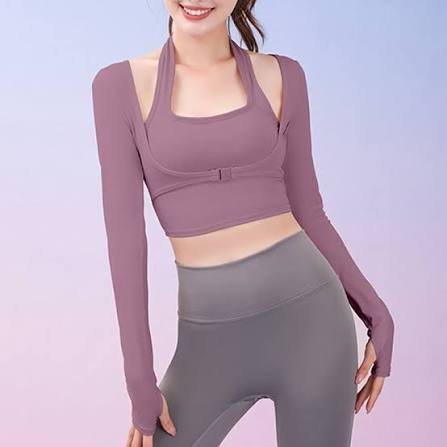
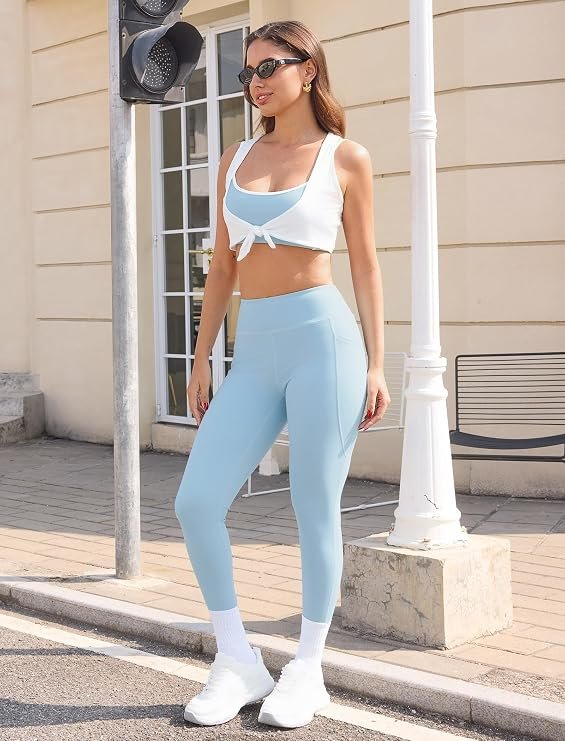
A seamless crop top and leggings may share a visual rib or jacquard language while differing in garment extension and local structure. Top length, body fit and neckline construction need their own references, as do legging waist, hip and inseam specifications. Coordinated-set approval should evaluate both garments together under the agreed color and presentation conditions.
Components: Seamless Crop Top · Seamless Leggings · Coordinated Knit Texture · Separate Fit Charts
Tank and Biker Shorts
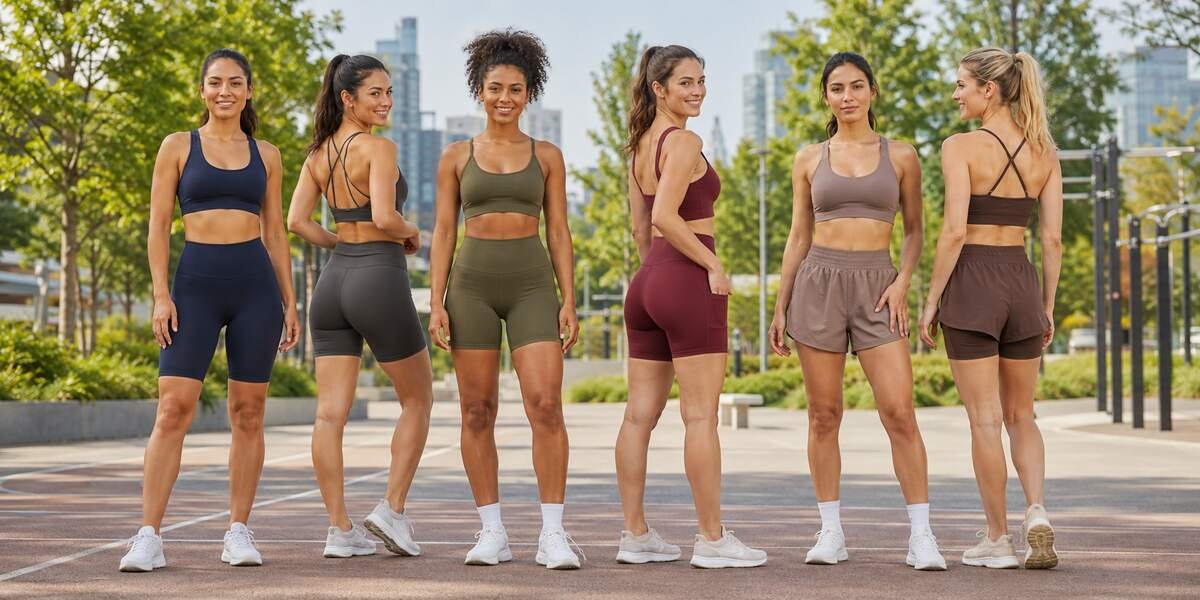
A seamless tank and biker shorts set can be developed around a related yarn direction and visual texture while retaining different requirements for the upper torso and lower body. Armholes, body length, shorts waistband and leg openings should be considered individually. The sourcing brief should also define whether these products will be sold independently or as fixed retail combinations.
Components: Seamless Tank · Biker Shorts · Shared Colorway · Product-Specific Measurements
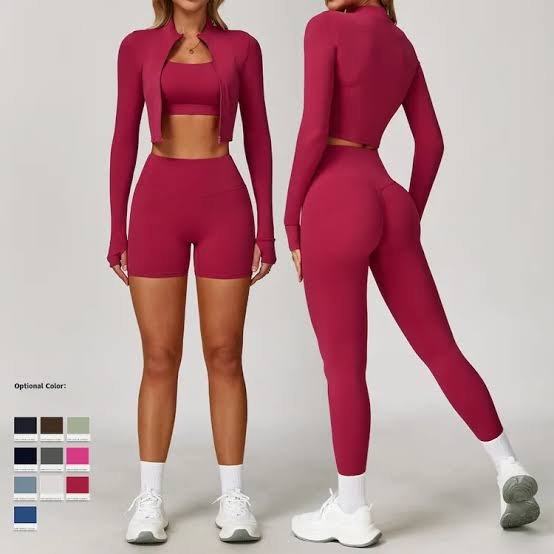
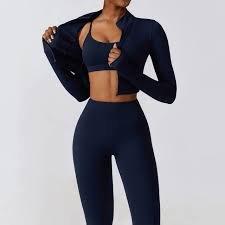
Three-Piece Seamless Capsule
A three-piece capsule may combine a sports bra, coordinating top and leggings or shorts. The additional garment increases specification, color, size and quantity complexity. Brands should define which elements share a reference and which require separate approval. A structured RFQ becomes especially important when each SKU has different forecast demand, yarn requirements or replenishment conditions.
Components: Sports Bra · Seamless Top · Leggings or Shorts · Collection Approval Reference
Coordinating Knit-Zone Architecture Across Different Seamless Garments
Matching surface texture does not mean identical knit construction. The same visual rib, mesh or jacquard idea may require different placement and mechanical behavior in a sports bra and leggings because their fit, coverage and movement needs differ.
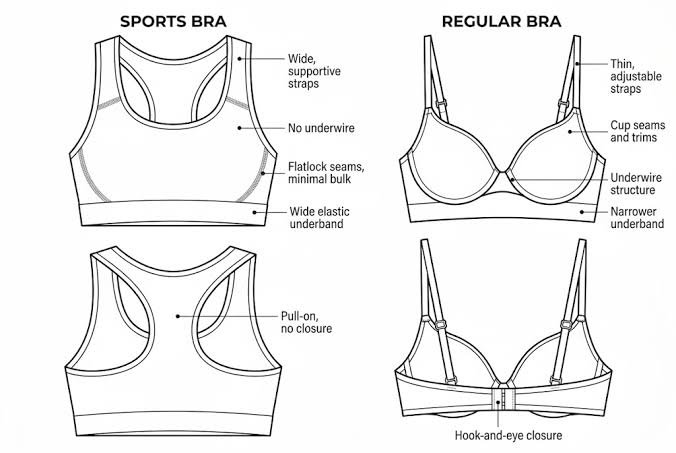
Bra Underbust
A structured underbust zone may influence local extension and band fit. Its construction should be reviewed against the approved bra specification rather than copied directly from a leggings waistband.
Bra Front Panel
Front-panel knit structure affects appearance and coverage. Designers should distinguish decorative texture from functional performance and consider how the fabric behaves when stretched during normal garment use.
Bra Back Mesh
Open knitted areas may contribute to a selected ventilation-oriented design. Placement must also consider coverage, stretch, surface integrity and the relationship between the back panel and surrounding structures.
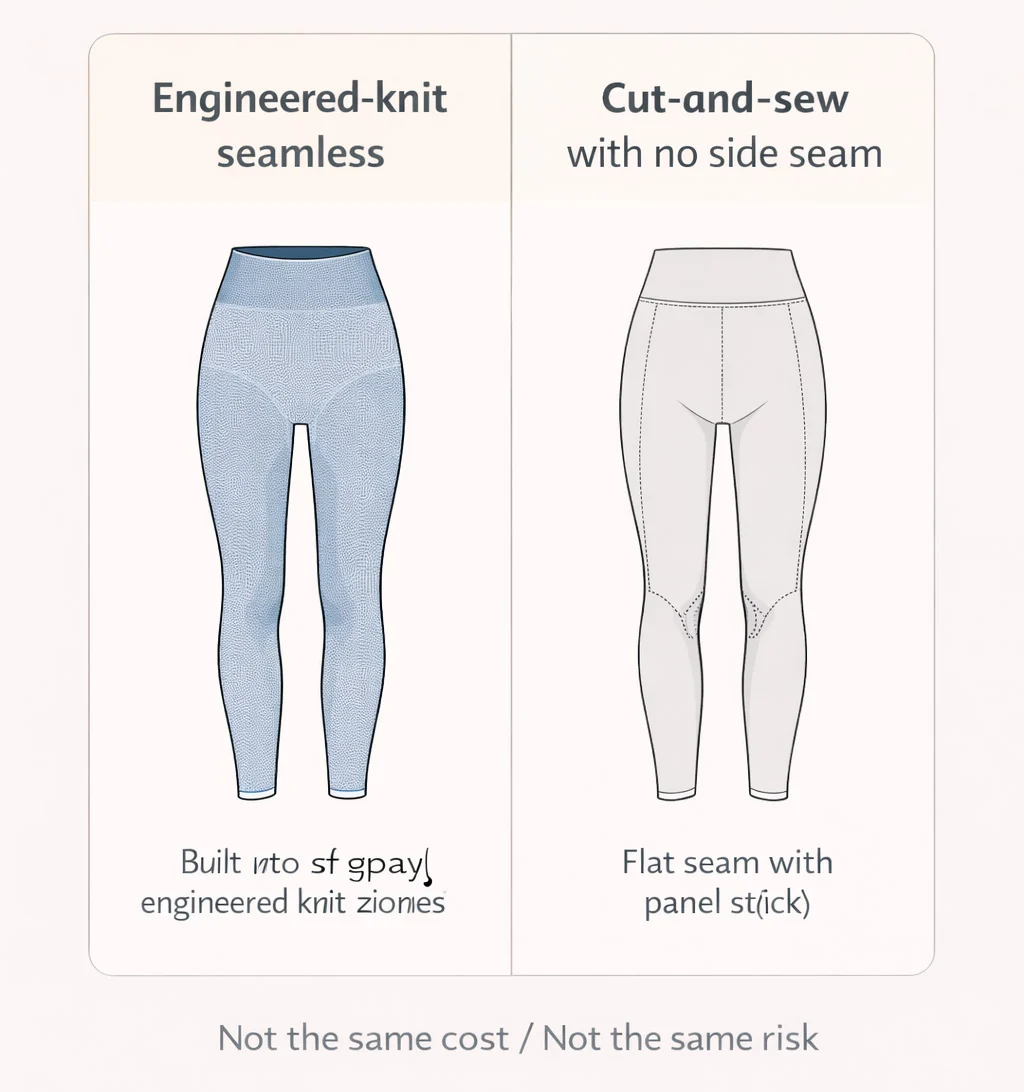
Leggings Waistband
A ribbed waistband may visually resemble a sports bra band but require different dimensions, recovery and resistance. The accepted effect should follow the leggings' own fit and measurement criteria.
Hip and Glute
Decorative or engineered knit zones around the hip and seat may change appearance under extension. Their placement and coverage should be checked against garment sizing and intended use.
Thigh Transition
Transitions between compact and open or textured knit areas can alter surface appearance and local extension. Buyers should evaluate their alignment, particularly when a similar pattern occurs in another set component.
Shorts Leg Opening
The shorts opening has different construction needs from the upper garment. Local knit density and finishing can affect its appearance and fit, requiring a garment-specific approval reference.
Technical Relationship Between Garments
Shared visual features should be translated into separate construction specifications for each product. Yarn construction, stitch geometry, machine suitability and finishing all influence dimensions and mechanical behavior. A pattern that appears balanced on a sports bra may require different scale or density on leggings. Size grading can also alter how a motif aligns with the wearer. For these reasons, the brand should approve both the common visual intent and the individual technical construction. MOVEVOX can discuss these variables through its seamless manufacturing and development resources, but final results require actual samples.
Testing Requirements for Individual Garments and Complete Sets
A collection may require laboratory testing, controlled garment measurements and physical visual approval. These methods answer different questions. Brands should define the tested article, relevant standard, sample condition and acceptance criteria before treating any result as evidence for the entire set.
Cross-Knit Shade Evaluation
Purpose: Assess whether differently constructed garments meet the buyer's intended visual color relationship. A shared nominal color code does not by itself establish acceptable appearance between rib, mesh and other knit surfaces.
Method: Compare representative material or finished garments under agreed lighting, viewing and physical conditions. Instrumental methods may assist where suitable, but their applicability must be checked for the specimens being compared.
Acceptance: Buyer-approved visual reference, observation conditions and documented decisions for intentional differences.
Laundering Colorfastness
Purpose: Determine whether the relevant textile sample maintains acceptable color behavior under a specified laundering procedure. This is different from judging whether two new garments have matching shades.
Method: Select an appropriate test, such as ISO 105-C06 where applicable, and define the tested material, detergent procedure, adjacent fabrics and reported changes or staining.
Acceptance: Reported results must satisfy the buyer's applicable method and acceptance requirements.
Fabric Elongation
Purpose: Evaluate how far a knitted material extends under defined conditions. Bra and legging fabrics may require separate targets because equivalent extension is not necessarily desirable.
Method: Select an applicable elasticity test, such as an appropriate ISO 20932-1 strip-based procedure. Specify specimen direction, loading and reporting conditions before comparing material results.
Acceptance: Product-specific elongation requirements for the tested construction and direction.
Elastic Recovery
Purpose: Assess the fabric's ability to return toward its initial dimensions after extension. Recovery may be especially relevant for underbust bands, waistbands and other fitted garment areas.
Method: Agree on the extension procedure, loading cycles where relevant, recovery interval and measurement state. Distinguish material specimens from finished-garment observations.
Acceptance: Defined recovery limits for each critical garment area and test procedure.
Residual Fabric Growth
Purpose: Identify permanent or persistent dimensional growth after a specified stretching and recovery procedure. Two fabrics with similar initial extension may show different residual growth.
Method: Record the starting specimen dimensions, apply the agreed load or extension sequence and measure residual change after the stated recovery condition.
Acceptance: Buyer-approved residual growth limits, reported with the relevant test conditions.
Dimensional Change
Purpose: Evaluate whether cleaning or other specified treatment changes a garment's dimensions. Such changes may alter size pairing or the visible placement of coordinated knit features.
Method: Use a suitable washing or treatment procedure and an applicable dimensional assessment method. Record the specimen, treatment details and measured directions.
Acceptance: Approved dimensional-change limits for each relevant SKU and treatment method.
Opacity Under Extension
Purpose: Assess coverage where a knitted product is expected to stretch during wear. Coverage requirements for leggings may differ from those of a sports bra or tank top.
Method: Define garment or material extension, observation conditions and a suitable evaluation procedure. Do not equate fiber composition or GSM alone with proven opacity.
Acceptance: Buyer-approved coverage requirements for the specific garment and assessment condition.
Garment Fit Review
Purpose: Confirm that the finished article meets intended wearer, sizing and construction requirements. Fabric measurements alone cannot establish correct bra support, legging fit or set compatibility.
Method: Use approved size specifications, relevant fitting samples and a consistent review procedure. Record each garment's result separately and perform an additional set appearance review.
Acceptance: Separate garment approval plus the applicable complete-set requirements.
Six Development Decisions That Affect Seamless Set Approval
A collection can encounter problems even when individual products are technically feasible. Brands should identify which requirements depend on another garment and which changes could affect sourcing, approval, launch timing or future replenishment before confirming the production route.
Visible Shade Differences
Business Impact: A sports bra and leggings may satisfy separate material references yet appear inconsistent when displayed together. Late discovery can delay collection approval and create uncertainty about how much visual difference the buyer will accept.
Proposed Response: Establish a physical collection reference and compare garments with their actual knit structures. Agree on observation conditions, intentional differences and the authority required to approve a coordinated colorway before bulk production decisions.
Yarn Substitution
Business Impact: Changing the yarn of one garment may affect extension, recovery, surface appearance or color response. The revised article could become technically different from its previously approved counterpart within the coordinated collection.
Proposed Response: Identify the affected SKU and assess the substitution against both individual specifications and shared set requirements. Determine whether trial knitting, color comparison or additional testing is necessary before buyer authorization.
Different Elastic Performance
Business Impact: Using identical elastic-performance targets for a bra and leggings may create unsuitable fit or construction decisions. Changes intended to improve one component can also affect its relationship to the collection's visual pattern.
Proposed Response: Approve garment-specific performance requirements and distinguish them from shared appearance standards. Use appropriate samples and methods to evaluate critical areas without implying that visually matching garments must have identical mechanical behavior.
Mixed Size Pairing
Business Impact: A fixed-size bundle may not reflect how consumers select bra and legging sizes. Unclear pairing rules can create unsaleable combinations, inventory imbalance or inaccurate quotation and packing assumptions.
Proposed Response: Confirm separate technical size charts and the brand's intended commercial pairing model. Align SKU identification, quantity breakdown and packing instructions with that decision before order approval.
Program Revision Conflicts
Business Impact: Revising knit density, zone placement or garment dimensions on one product may alter its appearance beside other collection members. A sample revision may therefore affect more than the modified SKU.
Proposed Response: Record the proposed change and evaluate whether it touches shared collection characteristics. Retain separate product approvals while identifying when an additional full-set comparison is needed.
Uneven Product Readiness
Business Impact: One garment may complete development or production before another. If the retailer requires complete sets, the slower component can determine the commercial availability of the entire collection despite finished stock elsewhere.
Proposed Response: Identify dependencies between SKU approvals, material readiness, production completion and packing requirements. Use the proposed delivery plan to establish which decisions must be completed before an entire set can be released.
Review Your Seamless Set Before Sampling Begins
Share your upper and lower garment specifications, preferred knit structures, yarn direction, color references and expected quantities. MOVEVOX can discuss manufacturing feasibility and identify the technical questions that should be resolved for each garment and the coordinated collection before sampling, quotation or commercial production commitments are confirmed.
Supporting Note: Feasibility, testing, material availability, sample costs and timing remain subject to project review and agreement.
Developing Separate Seamless SKUs Within One Collection
A seamless collection needs both shared project direction and independent garment approval. The following proposed development sequence connects those responsibilities without assuming that all related SKUs use one knitting program, one fit standard or one material.
Step 01 — Collection Brief
Define the planned garments, intended commercial combinations, common color direction and individual performance objectives. Record which technical details are already approved and which require development review. Clear distinctions at this stage help prevent a shared visual objective from being mistaken for an identical construction requirement.
Buyer Inputs
- Identify all intended garments and their commercial combinations.
- Supply existing sketches, samples and available technical specifications.
Proposed MOVEVOX Outputs
- Discuss manufacturing suitability using available seamless development capabilities.
- Identify missing individual and shared collection requirements.
Pass Criterion: The buyer confirms the collection scope and the technical questions requiring sample development or further review.
Step 02 — Individual Trials
Develop or assess each garment against its own critical specifications. A bra and leggings may use different structural zones, elastic arrangements and dimensions even when they share a collection appearance. Initial technical comparisons should focus on the product requirements rather than forcing premature visual uniformity.
Buyer Inputs
- Provide garment-specific measurements and relevant performance priorities.
- Confirm preferred knit references, materials and adjustment permissions.
Proposed MOVEVOX Outputs
- Discuss appropriate sample routes for each garment.
- Clarify technical revisions and available construction alternatives.
Pass Criterion: Each relevant garment sample is ready for buyer evaluation against its own stated technical requirements.
Step 03 — Set Comparison
Review the garments together to evaluate color appearance, visual texture, branding and the intended size-pairing relationship. Where a difference is intentional, document it as an approved design decision. Where the buyer requires closer matching, identify the affected garment and appropriate revision route.
Buyer Inputs
- Review physical color and texture matching across products.
- Identify acceptable differences under agreed observation conditions.
Proposed MOVEVOX Outputs
- Discuss potential adjustments and their manufacturing implications.
- Identify whether additional yarn or knit trials are appropriate.
Pass Criterion: Shared collection requirements are approved, revised or explicitly left open for further investigation.
Step 04 — Separate Approvals
Confirm the accepted version of each garment, including relevant dimensions, construction, material references and outstanding technical conditions. A complete-set appearance decision should not erase the independent approvals needed for each SKU to be produced and inspected.
Buyer Inputs
- Approve or reject each garment's current technical reference.
- Confirm outstanding tests and acceptance responsibilities for each SKU.
Proposed MOVEVOX Outputs
- Connect accepted sample references with the relevant project specifications.
- Clarify production information required before commercial order confirmation.
Pass Criterion: Each product has a clearly identified approval status and any remaining exceptions have been addressed appropriately.
Step 05 — Collection Release
Review the combined commercial requirements, including colors, size breakdowns, quantity units, packing rules and timing. This is the point at which the buyer determines whether separately approved garments can proceed together as a commercially acceptable collection.
Buyer Inputs
- Confirm quantity, color, size and packing requirements by SKU.
- Authorize remaining collection-level commercial decisions and specifications.
Proposed MOVEVOX Outputs
- Review applicable MOQ, material availability and production scheduling conditions.
- Discuss inspection and order-execution requirements for the proposed collection.
Pass Criterion: The buyer's individual-product and coordinated-collection requirements are sufficiently clear for the agreed production and purchasing decisions.
First Article Checks for Complete Seamless Set Readiness
Production readiness should be assessed separately for each garment and jointly for the coordinated set. These proposed checkpoints help distinguish a correct first article from a collection that still has unresolved color, size, material or packing requirements.
01 — Material Reference
Verify the materials associated with the first articles against the approved specifications. A change to one component may affect mechanical behavior or its appearance beside the other garment. Any unexplained substitution should be reviewed before the affected product is released.
Check Standards
- Approved yarn and material references match the actual production inputs.
- Document any variation requiring renewed technical or buyer authorization.
Status: Confirm / Review
02 — Bra First Article
Assess the first bra against its approved construction, measurements and relevant fit requirements. Check critical regions such as the underbust and other engineered zones, while recognizing that a visual surface inspection cannot replace required functional evidence.
Check Standards
- Knit structure and important zones correspond to the approved bra sample.
- Critical dimensions meet the agreed garment measurement requirements.
Status: Confirm / Review
03 — Bottom First Article
Evaluate the first leggings or shorts against the applicable product specifications. Relevant checks may include waistband structure, hip or thigh regions, leg opening and relaxed dimensions. Approval of the bra does not authorize release of the bottom garment.
Check Standards
- Critical construction features match the approved bottom reference.
- Required dimensions and appearance meet the agreed inspection criteria.
Status: Confirm / Review
04 — Knit-Zone Position
Compare the intended locations of shared visual motifs and independent functional zones. A matching texture may be deliberately scaled or positioned differently across garments. The relevant criterion is the approved requirement, not identical coordinates between products.
Check Standards
- Functional zones appear in the approved garment-specific positions.
- Shared visual patterns meet the intended collection appearance requirements.
Status: Confirm / Review
05 — Dimensional Approval
Measure each garment using its agreed POMs and measurement state. Elastic products may produce different values when handled or stretched inconsistently. The buyer should distinguish dimensional tolerances from unrelated expectations about complete-set sizing or retail pairing.
Check Standards
- Garment state and measuring procedure follow agreed requirements.
- Observed measurements are evaluated against approved product-specific tolerances.
Status: Confirm / Review
06 — Shade Comparison
Compare the first production garments under the agreed visual reference conditions. Consider surface texture and knit extension where relevant. Separate color specification conformity from the additional judgment of whether the two garments form an acceptable set.
Check Standards
- Each garment meets its approved material or color reference.
- Complete-set appearance is evaluated against buyer-approved coordination requirements.
Status: Confirm / Review
07 — Size Pairing
Check that the intended upper and lower sizes can be identified and associated with the correct commercial configuration. Fixed bundles and independently selectable products have different requirements for SKU mapping, order quantity and eventual packing.
Check Standards
- Top and bottom size identifiers match the confirmed SKU specifications.
- The intended pairing model agrees with the approved order instructions.
Status: Confirm / Review
08 — Release Decision
Review unresolved findings and confirm which products or sets may proceed. A completed inspection record is useful only when the acceptance conditions and decision authority are clear. Product-specific approval should not be confused with release of a complete retail bundle.
Check Standards
- Outstanding deviations have a documented disposition or buyer decision.
- The authorized release reflects both garment and collection requirements.
Status: Confirm / Review
Handling Nonconforming First Articles
If a first article differs from an approved requirement, the relevant product should be reviewed before affected production is expanded. Possible responses include repeat measurement, additional inspection, material investigation, corrective work or a revised sample. Where the problem affects shared set requirements, the corresponding garment should also be considered. The precise control and release procedure must follow the confirmed customer specification and MOVEVOX's applicable production arrangements.
When Individually Acceptable Garments Fail Set Approval
A seamless set may require additional inspection even when its garments pass separate checks. The matrix focuses on cross-SKU differences that affect a coordinated commercial product rather than repeating a general list of knitting-machine defects.
Cross-SKU Quality Decision Matrix
| Defect / Inconsistency | Likely Cause | Prevention | Inspection Point | Corrective Action |
|---|---|---|---|---|
| Cross-Knit Shade Mismatch | Different yarns, surface structures, finishing conditions or batches may create visible differences between a bra and leggings despite related color specifications. | Establish a complete-set color reference and review actual garment structures before approving production. Identify whether visual differences are intentional or unacceptable. | Compare the finished garments together under agreed observation conditions rather than relying only on isolated fabric or yarn color checks. | Determine which garment or material requires investigation. Recompare approved references and seek buyer disposition where necessary before accepting the affected set. |
| Texture Inconsistency | Rib, jacquard or textured zones may differ in pattern scale, density or appearance across products even when they share a nominal design theme. | Approve the intended visual relationship between garment-specific structures. Use realistic product samples rather than assuming one program can be transferred unchanged. | Review the coordinated garments for motif consistency, pattern placement and appropriate differences between functional zones. | Investigate the affected specification or program, then decide whether to revise the item or accept the intentional construction difference. |
| Elastic Specification Conflict | Shared assumptions about stretch or recovery may be inappropriate for different garment functions, particularly across bra bands, waistbands and fitted lower-body regions. | Define garment-specific mechanical requirements separately from shared collection appearance. Use suitable sample evaluation and testing where needed. | Verify the relevant fabric or garment results against each SKU's approved requirements, not a single universal collection value. | Reassess the affected garment's construction and approval criteria. Do not change another product merely to force identical elastic results. |
| Incorrect Size Pairing | The production or packing instruction may not reflect independent upper and lower size charts or the brand's intended retail bundle configuration. | Confirm pairing rules, SKU identifiers and order quantities before final packing. Distinguish fixed combinations from mix-and-match purchases. | Compare selected sizes and identifiers against the approved order and the corresponding bundle or SKU specification. | Segregate incorrectly paired products and verify their identities before repacking or obtaining buyer instructions for a different allocation. |
| Lot-Related Appearance Change | A new yarn lot or finishing condition may alter one garment's shade or surface appearance while previously produced matching stock remains available. | Retain relevant approved references and identify which material or process changes require renewed collection comparison. | Compare new production with applicable approved samples and, where feasible, actual retained set components. | Investigate material and processing differences, then determine whether new approval is required before marketing garments as matching products. |
| Mixed Label or Barcode | Different styles, colors, sizes and bundle configurations can increase the risk of applying incorrect identification to individually acceptable garments. | Use the approved SKU breakdown and corresponding labeling instructions. Clarify whether the saleable unit is a garment or complete set. | Check item labels, packaging information and barcode assignments against the confirmed packing and order specifications. | Isolate affected merchandise, correct identification where authorized and recheck the relevant quantity and packing records before release. |
Packing Seamless Sets Without Losing SKU Accuracy
A set can involve several different commercial units: individual garments, fixed bundles, mixed-size combinations or three-piece packs. Correct identification starts with the brand's sales and order structure, not with the packaging format alone.
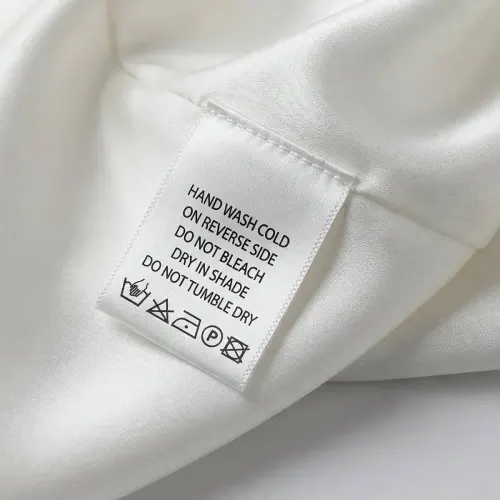
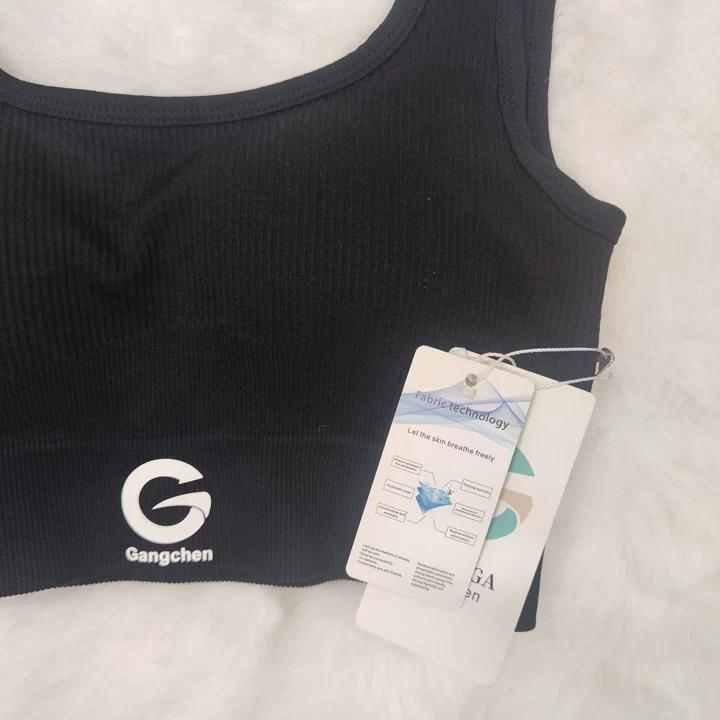
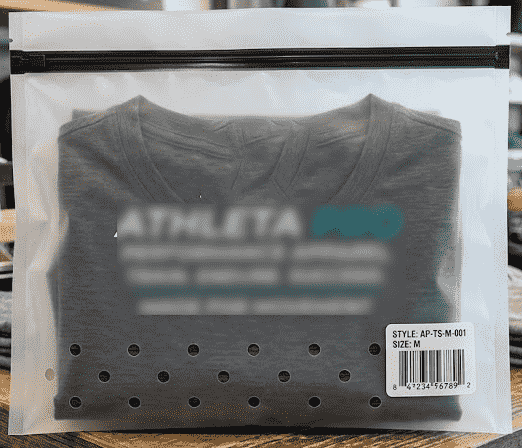
Garment Care Label
Each applicable garment should carry the required fiber, care and identification information under the relevant market and buyer requirements. A coordinated set may contain different yarn constructions, so copying one garment's label content onto another can create inaccuracies.
Specification Tags: Fiber Details · Care Instructions · Garment Identity
Individual Hangtag
Hangtags may be used to identify each separately saleable garment, including its style, color and size. When several products belong to one coordinated collection, a shared visual design should not obscure product-specific information needed for retail or warehouse handling.
Specification Tags: Style Code · Size Label · Brand Artwork
SKU Barcode
The barcode assignment should follow the confirmed product or bundle identifier. A sports bra and leggings can have different item-level SKUs even when sold as a coordinated set. Any separate bundle barcode must represent the actual intended commercial unit.
Specification Tags: Item SKU · Bundle SKU · Barcode Standard
Set Packing Configuration
A fixed-size two-piece set needs a defined component combination and quantity. Independently selectable products may instead require separate packaging. The brand should confirm which approach applies before the factory receives final packing and quantity instructions.
Specification Tags: Fixed Bundle · Mix-and-Match · Quantity Check
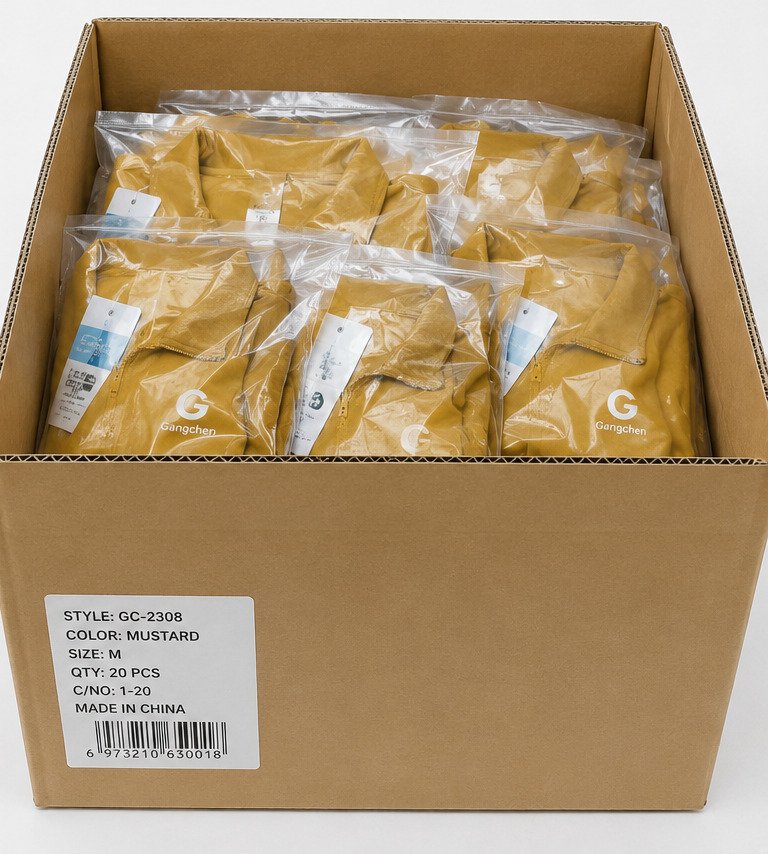
Carton Identification
Carton marks and packing lists should reflect the goods actually packed, including style, color, size and quantity. Where complete sets are shipped, the documents should distinguish set counts from individual garment counts to reduce receiving and allocation errors.
Specification Tags: Carton Mark · Packing List · Quantity Basis
Packaging and Regulatory Review
Packaging artwork, textile labels and barcodes require appropriate review before bulk application. Applicable requirements may differ between European, U.S. and Canadian markets, and a complete set can contain components with different fiber information. Buyers should provide their accepted labeling and packaging specifications, including who authorizes any change. MOVEVOX supports private-label packaging and order execution, while particular configurations remain subject to project confirmation.
Connecting Separate Production Lots to One Approved Set
A coordinated set may involve separate yarn references, knitting instructions and production batches. The following proposed traceability framework connects the two garment paths to a shared collection decision. It is not a claim that MOVEVOX operates an existing digital traceability platform.
01 — Collection Reference
Identify the approved colorway, intended visual knit language and relevant commercial set definition. These shared requirements provide the comparison basis but do not replace the technical specifications belonging to each individual garment.
02 — Bra Material
Record the applicable yarn and material references for the sports bra, including available lot information. Changes to the approved construction should be assessed against the bra specification and any shared collection requirements.
03 — Bottom Material
Identify the corresponding material requirements for leggings or shorts. The bottom may use different yarn construction while remaining visually coordinated, making its individual material reference important for quality review and future replenishment.
04 — Knit Specifications
Connect each garment's approved structure and relevant program reference to the correct product version. Similar rib or jacquard appearances should not be treated as proof that both garments share identical machine instructions.
05 — Garment Approvals
Retain an identifiable approved sample or specification reference for each SKU. The approval should establish which garment-level characteristics are accepted and which additional tests or conditions remain applicable to production.
06 — Production Lots
Associate the actual production with relevant material lots, style identifiers and order references. Where a component is produced separately, its lot identity should remain distinguishable from that of its matching garment.
07 — Set Comparison
Compare the applicable finished garments against the approved shared collection standard. This step should identify whether shade, texture, size pairing or presentation concerns require further review beyond individual product acceptance.
08 — Packing Release
Confirm that accepted garments are associated with the correct SKU and packing instructions. The final documentation should accurately identify shipped pieces and complete sets without assuming those quantities are interchangeable.
Important Clarification
The two-path traceability model is a recommended framework based on actual material, development and quality management needs. Detailed records, responsible systems and buyer reporting arrangements require internal and project-specific confirmation.
Managing Partial Reorders Without Losing Collection Compatibility
A brand may need more leggings while matching bra inventory remains available. The correct reorder decision depends on material references, approved construction, new production conditions and the intended relationship to existing stock—not simply on whether the style number remains unchanged.
Tab 01 — Same Approved Program
A repeat order using the same approved garment specifications may be more straightforward than a new development program, but the buyer should still confirm material availability, color references, size quantities and packaging requirements. A previous sample approval provides a reference, not automatic assurance that all later production conditions remain identical. Applicable quality and shipment requirements should be reviewed before the order proceeds.
Buyer Inputs
- Confirm the approved style version and original material references.
- Provide the required size, color and quantity breakdown.
- Identify whether new stock must match existing set components.
Proposed MOVEVOX Outputs
- Review material and production suitability for the requested repeat.
- Discuss relevant reference samples and quality requirements.
- Confirm project-specific MOQ and scheduling assumptions before quotation.
Tab 02 — Bottom-Only Reorder
When leggings sell faster than the corresponding sports bra, the brand may purchase only the bottom garment. The manufacturing review should establish whether new leggings must visually match older bra stock or will be sold independently. That decision affects the importance of old/new lot comparison, shade reference availability and permissible production changes. Garment-level specification acceptance remains necessary in either case.
Buyer Inputs
- Confirm the quantity and specifications of the leggings reorder.
- Explain whether the new bottoms must match existing bras.
- Provide retained reference garments or agreed shade standards where available.
Proposed MOVEVOX Outputs
- Discuss availability of approved materials and knitting requirements.
- Identify whether a new visual comparison should be considered.
- Clarify MOQ, sampling and delivery implications for partial quantities.
Tab 03 — New Yarn Lot
A new yarn lot can introduce appearance or physical variation even when the composition description remains unchanged. Buyers should identify the characteristics that must stay consistent with the approved product and decide whether the updated material requires sampling or testing. Cross-garment appearance may be especially important when the reordered article will be paired with existing collection inventory.
Buyer Inputs
- Identify the approved yarn specification and relevant older references.
- Confirm critical color, stretch and appearance acceptance requirements.
- State whether existing-stock compatibility is commercially required.
Proposed MOVEVOX Outputs
- Review the proposed material reference and sourcing availability.
- Discuss necessary knit or garment comparisons before approval.
- Clarify implications for order timing and acceptance evidence.
Tab 04 — New Colorway
A new colorway is not necessarily a routine repeat of the original collection. Different yarns or knit structures may produce distinct visual results, and additional material procurement conditions may apply. The brand should approve each relevant garment color and the complete set's appearance. Quantities, labeling artwork and color-specific SKU references also need to be updated before order confirmation.
Buyer Inputs
- Supply the new collection color reference and intended products.
- Confirm which garment structures and sizes remain unchanged.
- Provide estimated quantities by style, color and retail configuration.
Proposed MOVEVOX Outputs
- Discuss material sourcing and new-color feasibility requirements.
- Identify physical color approval needs for separate garment structures.
- Review affected MOQ, sample and production schedule conditions.
Tab 05 — Revised Knit Program
A program or structure revision may affect garment dimensions, knit-zone placement, stretch or visual appearance. The buyer should decide whether the revised product replaces the older version or must remain compatible with existing stock. Technical changes should be assessed against the relevant SKU specification, with additional collection comparison where they affect a shared appearance or commercial requirement.
Buyer Inputs
- Identify the requested construction changes and affected products.
- Provide the previous approved specification and sample references.
- Confirm whether compatibility with earlier collection stock is required.
Proposed MOVEVOX Outputs
- Review modification feasibility against available knitting capabilities.
- Discuss the sampling and reapproval implications of the change.
- Clarify any revised commercial assumptions before production planning.
Comparing Total Sourcing Costs Across Seamless Set Programs
A complete-set price is not meaningful without understanding the component quantities, specifications and development assumptions behind it. Different collection structures can change yarn procurement, sample work, machine scheduling, inspection, packing and replenishment requirements even when total garment quantities appear similar.
Sourcing Model Comparison
| Cost Factor | Standard Two-Piece Set | Custom Two-SKU Program | Multi-SKU Capsule |
|---|---|---|---|
| Development Work | An existing construction may reduce development complexity, provided required colors, sizes and garment details remain suitable. | Separate bra and bottom engineering may require more trials, fit approval and coordination across shared collection requirements. | Several products create more specification dependencies and may require staged development before all styles can be approved. |
| Yarn Procurement | Suitable available materials may offer simpler initial sourcing, subject to actual supplier and stock conditions. | Different constructions may need independent yarn specifications, color development or purchasing minimums for each garment. | Shared and separate material needs should be compared across the complete product range before confirming assumptions. |
| Color Approval | Existing color references may provide a starting point, but the actual garments still need appropriate review. | Different knit structures can require additional cross-garment comparison and separate acceptance of material and complete-set appearance. | Multiple fabrics, colors and texture combinations increase the number of relevant comparisons and approval records. |
| Sampling Revisions | A limited adjustment may affect only one product, although collection-level impact should still be considered. | Changing one component may require another set comparison, even if its matching garment remains technically unchanged. | Shared decisions and individual program changes can create interdependent sampling work that should be planned carefully. |
| Production Setup | Similar materials or approved constructions may simplify selected operations, depending on available equipment and order conditions. | Different knitting programs and quantities can create distinct preparation, scheduling and production requirements. | Multiple SKUs and colors may increase program changes, material coordination and production scheduling complexity. |
| Quality Inspection | Each garment still requires appropriate inspection, with relevant complete-set appearance and packing checks where applicable. | Separate specifications and shared visual standards create different acceptance tasks that should not be merged. | More products and lots can increase the amount of inspection coordination and material reference management. |
| Retail Packing | A fixed bundle may simplify certain customer-facing decisions but requires accurate component and size pairing. | Individual SKU sales and complete-set bundles may need separate identifiers and packing instructions. | Mixed bundles, independent sales and multiple sizes can create more inventory and fulfillment combinations. |
| Replenishment Exposure | Reorders may rely on available approved materials and existing references, subject to current production conditions. | Unequal sales of bra and leggings can create partial replenishment and cross-lot matching requirements. | Broader SKU demand variation can increase the complexity of stock balancing and future ordering decisions. |
Interpreting Total Cost
A lower quoted unit price does not necessarily represent a lower total sourcing cost. The buyer should consider development work, required testing, production quantities, material minimums, potential delays, inspection and the effect of unbalanced stock. Conversely, a more complex technical approach is not automatically better merely because it includes additional controls. The appropriate sourcing plan is the one that meets the collection's intended performance and commercial needs under confirmed assumptions. This table is a qualitative decision framework; it contains no actual MOVEVOX customer cost savings, profit figures or historical quotation results.
How MOQ Is Calculated for Different Seamless Set Orders
MOQ should identify the unit to which a minimum applies. A two-piece set contains multiple garments, while each style, color and yarn requirement may carry separate manufacturing conditions. MOVEVOX's conditional seamless starting MOQ should not automatically be interpreted as a guaranteed quantity of complete sets.
Standard Two-Piece Set
This scenario covers a bra and leggings combination using suitable existing or manageable construction and material requirements. MOVEVOX's normal seamless customization starting point can be around 100 pieces, subject to project conditions. The buyer must confirm whether that reference applies to each SKU and how the quantities form complete sets. A commercial set quantity cannot be inferred from the total garment count without considering product and size allocation.
Quantity Basis: Approximately 100 pieces as a conditional garment-level entry reference; actual SKU and set minimums require confirmation.
Color / Size Split: Confirm separately for each garment, then calculate valid pairings.
Cost Factors: Material availability, quantities, branding and packing requirements.
Custom Multi-SKU Program
A collection containing several tops, bras, leggings and shorts can involve different knit programs, color requirements and yarn procurement conditions. The applicable MOQ may vary between components. Combining their total quantity does not necessarily satisfy the minimum for every individual product. Buyers should provide separate style, color and size forecasts, allowing the manufacturing proposal to distinguish development needs from commercial garment quantities.
Quantity Basis: Project-specific minimums for the relevant styles and production conditions.
Color / Size Split: Evaluated by program, material and available production arrangement.
Cost Factors: Sample development, knitting changes, yarn sourcing and SKU complexity.
Partial Replenishment Order
A brand may reorder leggings without purchasing additional bras. That order should be evaluated as an independent production requirement, including material availability, color reference, program version and actual garment quantity. Previous collection approval does not establish that the earlier MOQ or pricing will remain applicable. Where new stock must match older components, any necessary technical comparison can also affect timing and project conditions.
Quantity Basis: Confirmed minimum for the specific reordered garment and relevant material conditions.
Color / Size Split: Based on replacement demand and buyer pairing requirements.
Cost Factors: Yarn lots, new setup, color matching and inspection needs.
Planning Separate Garment Timelines for One Set Delivery
A complete set cannot be commercially released merely because one component is finished. Material readiness, sample approvals, individual knitting schedules, inspection and packing requirements can create dependencies between related SKUs. The following is a planning framework, not a confirmed order schedule.
Proposed Multi-SKU Production Timeline
| Phase | Timing Basis | Prerequisite | Buyer Confirmation |
|---|---|---|---|
| Material Review | Project-specific | Bra and bottom material requirements | Confirm acceptable material references |
| Sample Development | Normally 5–10 working days after standard development details are confirmed, subject to complexity | Available specifications and development scope | Review individual garment samples |
| Collection Approval | Buyer-dependent | Individual samples and shared appearance requirements | Confirm separate and set-level approvals |
| Bulk Allocation | Schedule-dependent | Confirmed PO, material readiness and production release | Accept agreed production assumptions |
| Bra Production | Order-specific | Approved bra construction and available resources | Review progress where agreed |
| Bottom Production | Order-specific | Approved bottom construction and available resources | Review progress where agreed |
| Set Inspection | Product- and lot-dependent | Relevant finished garments available | Confirm applicable acceptance requirements |
| Packing and Shipment | Order-specific | Approved goods, quantities and documentation | Confirm shipping and packing instructions |
Factors Affecting Delivery
Standard bulk production is commonly discussed around 20–35 days under confirmed conditions, but a coordinated collection may require different material paths, sample rounds or machine schedules. The overall timing depends on the slowest required production or approval activity, not simply the earliest completed SKU. MOVEVOX's managed combined capacity must not be represented as guaranteed dedicated seamless-set machine availability. Dates and delivery quantities require project confirmation.
The Manufacturing Resources Supporting MOVEVOX Seamless Set Projects
MOVEVOX combines a Yiwu manufacturing base with product development and quality resources. These figures provide a factual starting point for supplier evaluation; individual seamless set feasibility still depends on specific construction, quantities and production allocation.
28 Santoni Machines
MOVEVOX has 28 Italian Santoni seamless knitting machines. Actual compatibility with individual garment structures and available production slots requires project-specific evaluation.
Approximately 8 Developers
The product development organization includes design, patternmaking and sampling personnel. This figure does not mean all eight people are dedicated knitting-program engineers.
5 QC Personnel
MOVEVOX has five QC personnel supporting its quality management organization. Project-specific inspection plans and additional evidence requirements must still be agreed.
Approximately 6,000 m²
This figure refers to the company's actual operating space. It is not a measure of dedicated seamless knitting floor area or available machinery.
150,000–200,000 Pieces Monthly
This is the normal managed combined delivery capability across owned and controlled cooperating production resources, not exclusive seamless-set machine output or guaranteed project availability.
Data Scope: Figures describe MOVEVOX operating resources; production availability depends on actual projects and confirmed allocations.
Prepare Your Technical RFQ for Coordinated Seamless Sets
An effective set quotation requires both garment-specific and collection-level information. Buyers should identify what is fixed, what remains open for development and how products will be sold or packed. This reduces ambiguity around materials, sampling, MOQ and production quantities.
Collection Product List
Required
Identify every intended garment in the collection, including sports bras, leggings, shorts or tops. Explain which products belong to fixed bundles and which are sold independently. This establishes the number of technical specifications and the commercial units involved in the RFQ.
Individual Tech Packs
Required Where Available
Provide a separate Tech Pack or clear reference for each garment, including design sketches and relevant construction details. When documentation is incomplete, identify which elements have been approved and which need development discussion before a detailed quotation can be finalized.
Knit Structure References
Recommended
Show the intended rib, mesh, jacquard or textured regions for each product. If garments should share a visual knit language, identify the relationship without assuming identical knitting instructions. Physical reference samples or accurate close-up photographs can clarify the intended effect.
Yarn Requirements
Recommended
Include composition, available yarn specifications and any mandatory material references. Clarify whether the brand requires shared yarn construction or permits related materials that better suit individual garments. Special yarn or color procurement conditions may affect development and minimum order quantities.
Shared Color Standards
Recommended
Provide the physical or other agreed color references for each intended colorway. Specify whether matching appearance between differently constructed garments is a critical acceptance requirement and which observation conditions or retained samples should guide the approval discussion.
Garment Performance
Project-Dependent
Identify relevant stretch, recovery, coverage, support or dimensional requirements separately for each product. Include existing test methods and acceptance limits where available. If a performance description remains qualitative, mark it for technical clarification instead of assuming it is measurable as written.
Separate Size Charts
Recommended
Supply independently approved upper and lower size specifications. Note critical measurement points and fit references. If size development assistance is required, state the intended size range and which fit or grading decisions remain open for review.
Size Pairing Rules
Required for Bundles
Explain whether customers buy fixed size combinations or select upper and lower garments independently. Provide relevant pairings and SKU rules. The sourcing team needs this information to distinguish complete saleable sets from the number of individual garments being manufactured.
Set Approval Requirements
Recommended
Define shared collection acceptance criteria, such as visible shade coordination, texture relationships, branding and presentation. These requirements should be separate from each garment's technical approvals. Identify any existing complete-set reference sample that the proposed development or production must match.
Quantity Breakdown
Required for Pricing
Specify forecast quantities by garment, style, color and size. State complete-set quantities separately when applicable. Indicate whether independent replenishment is expected, because unequal future demand for tops and bottoms may affect material, production and quotation assumptions.
Branding and Packing
Project-Dependent
Provide approved artwork, label requirements, barcode assignments and intended packaging. Clarify whether products will be sold as separate pieces, fixed bundles or mixed-size combinations. Different commercial configurations may require different packing instructions and quantity records.
Development Schedule
Recommended
Provide the intended sample review schedule, target launch date and required shipment timing. Identify any third-party testing, material approval or vendor qualification stages that could affect the project. Timing remains subject to confirmed specifications and production availability.
When Your Brief Is Incomplete
MOVEVOX can begin a project discussion using a Tech Pack, lawful physical reference sample or clearly defined product requirements. Missing information should be distinguished from approved specifications so that development assumptions remain transparent. Material availability, machine suitability, sample timing, MOQ, testing and production schedules require project-specific confirmation before they become commercial commitments.
Frequently Asked Questions About Seamless Activewear Sets Manufacturing
These questions address the technical and purchasing issues that arise when several seamless garments must operate as one collection. The answers distinguish established MOVEVOX capabilities from project-specific evaluation, buyer approval and unverified performance claims.
Category A — Knit Engineering
Can the bra and leggings use different knit structures?
Yes. Coordinated appearance does not require identical construction. A sports bra may have specific underbust or back-mesh requirements, while leggings need their own waistband, hip and leg specifications. Similar ribs or jacquard patterns can establish a shared design language without producing identical mechanical behavior. MOVEVOX has seamless manufacturing and product development capabilities, but the feasibility of each structure depends on the actual yarn, machine configuration and design. Physical samples and appropriate specifications should guide the buyer's approval.
Must every garment use the same yarn?
No. A shared yarn may be appropriate when its construction suits the individual garments, but different product requirements may justify separate specifications. Similar fiber percentages do not ensure identical recovery, surface appearance or behavior during knitting and finishing. A sourcing review should identify which material properties are genuinely common and which must remain product-specific. Where different yarns are selected, their color appearance and compatibility with the intended collection should be evaluated using relevant physical references.
How can differently knitted garments share one color?
The brand can establish a shared color target, but final visual approval should consider the actual garments rather than relying only on the original color code. Yarn construction, surface texture, stitch density and stretching can change perceived appearance. A suitable comparison may include approved knit samples and finished garments under agreed conditions. Any instrumental color measurement must be relevant to the specimens and the chosen method. MOVEVOX does not claim a universal cross-knit color tolerance without product-specific evidence.
Can different seamless garments share jacquard or rib designs?
They can share visual themes where the knitting method and product geometry make those effects feasible. However, a pattern suitable for a bra may need changes in scale, placement or stitch arrangement when used on leggings or shorts. The material and size range can also affect the visible result. Buyers should approve the intended visual relationship together with each garment's independent construction. A matching texture should not be interpreted as proof that the products use the same knitting program.
Category B — Fit and Quality
Should the sports bra and leggings have identical stretch?
Not necessarily. Their fit and functional requirements differ. A bra's underbust area, a legging waistband and a thigh section can require different degrees of extension and resistance. Stretch, recovery and garment pressure are also different measurements. The brand should define relevant criteria for each garment and use appropriate samples or tests where required. Collection matching should focus on shared visual and commercial standards rather than imposing one mechanical target across unrelated body areas.
How should elastic recovery requirements be approved?
Recovery should be defined with a suitable test method, specimen or garment area, extension conditions and acceptance limits. A supplier should not assume that the presence of elastane guarantees a particular recovery value. For a coordinated set, recovery requirements may differ between the bra band, leggings waistband and shorts opening. MOVEVOX can discuss development and buyer-required testing, but actual compliance with a numerical recovery threshold requires relevant product-specific evidence rather than an unverified general claim.
What is the difference between garment and set approval?
Individual garment approval concerns the technical suitability of each product, such as construction, dimensions, fit and specified performance. Set approval concerns the agreed shared characteristics, such as visual color coordination, texture, size pairing, commercial SKU relationships and presentation. Both decisions may be necessary because two individually acceptable garments can still be unsuitable as a complete retail set. A dual-layer checklist is a recommended buyer-review approach, not a claim that MOVEVOX has already completed a particular customer's qualification program.
How should different top and bottom sizes be managed?
The brand should maintain separate technical size charts for upper and lower garments. It must then decide whether products are sold as fixed combinations or whether customers can choose both sizes independently. That decision affects SKU identification, order quantities, inventory and packing. A sufficient number of individual garments does not automatically produce the same number of saleable sets if certain sizes cannot be paired. MOVEVOX can discuss these specifications during product and order planning.
Category C — Sampling and Production
Can MOVEVOX develop a matching sports bra and leggings?
MOVEVOX has 28 Italian Santoni seamless knitting machines and a product development organization supporting customized activewear. It can discuss both garments using a Tech Pack, lawful physical reference sample or clear product brief. Final construction, materials and performance requirements need technical evaluation. A matching appearance should be approved separately from each garment's fit and structural requirements. Sampling time and applicable MOQ depend on the confirmed development details and product conditions.
Does a sample approval guarantee repeatable bulk quality?
An approved sample provides an important production reference, but it does not guarantee that every future garment will be identical under all conditions. Material lots, knitting settings, finishing, measurement and inspection can affect results. The buyer and manufacturer should define which specifications and quality requirements apply to production. MOVEVOX has existing approved-sample and QC practices, while additional cross-SKU records or verification procedures must be agreed for the particular collection.
What if one set component finishes production first?
Completion of one SKU does not necessarily mean a complete retail set is available. The buyer's approved commercial structure determines whether individual items can be shipped or whether the order must wait for the matching components. Production planning should therefore consider separate material readiness, technical approvals, knitting schedules and quality inspections. Set-level appearance or packing checks may also depend on both garments being available. The confirmed purchase agreement determines the applicable release and delivery arrangements.
Can MOVEVOX support a multi-SKU seamless collection?
MOVEVOX combines seamless knitting, product development and quality-managed production capabilities. These provide a basis for discussing related sports bras, leggings, shorts and tops. However, every SKU may have different material, machine, sizing and approval requirements. Buyers should provide a clear product list and quantity breakdown before capacity or timing is confirmed. Managed company-wide production capability must not be treated as dedicated available capacity for a particular seamless collection.
Category D — MOQ and Replenishment
Is the MOQ based on pieces or complete sets?
It must be clarified for each order. MOVEVOX's normal seamless customization entry point can begin around 100 pieces under suitable conditions, but that statement does not mean 100 complete two-piece sets are always available. Each garment, style, color and material arrangement may have its own constraints. The quotation should identify whether the minimum applies to individual pieces, a particular SKU, a colorway or a complete bundle, and should specify any yarn purchasing conditions.
Can leggings be reordered without the matching bra?
A partial reorder can be discussed, but its feasibility depends on the requested quantities, approved specifications, material availability and production conditions. If the new leggings must match previously manufactured bra inventory, additional review of shade appearance and other shared collection standards may be appropriate. The earlier set's MOQ, price or approval status should not automatically be extended to the new order. The buyer should provide existing references and identify which compatibility requirements remain important.
What happens when a yarn lot changes?
A new yarn lot can affect appearance or mechanical behavior even when the nominal composition remains similar. The implications depend on which material characteristics are critical and whether the reordered garment must match older stock. The proposed material should be reviewed against the approved garment specification, with additional sampling or testing where necessary. The buyer should also decide whether the change requires another complete-set comparison. No fixed outcome should be assumed without examining the actual material.
What should we provide for a complete set RFQ?
Provide the garment list, separate Tech Packs or reference samples, color and yarn preferences, size charts, estimated quantities by SKU and the intended sales or packing structure. Include relevant performance requirements and any approved collection reference. Explain whether products will be sold individually, as fixed bundles or with selectable sizes. These details allow MOVEVOX to discuss development needs, material constraints, MOQ assumptions and production timing more meaningfully. Missing specifications can be addressed during an initial technical review.
Start Your Seamless Set Development or Manufacturer Qualification Review
A coordinated seamless collection involves more than selecting matching garments. Each sports bra, legging, short or top requires its own technical approval, while the complete set may need additional color, texture, size-pairing and commercial verification. MOVEVOX provides a manufacturing foundation through its Santoni knitting equipment, product development team and quality management resources. Whether you are creating a new collection, transferring approved specifications or comparing potential manufacturing partners, the next step should reflect your current project information and outstanding technical decisions. Share your requirements so we can discuss an appropriate evaluation and purchasing route.
Send Us an Inquiry
Tell us your needs, and our team will get back to you within 24 hours.